
How to Select an Air Preheater Soot Blower: Rotor Geometry, Nozzle Layout and Cleaning Coverage
Selecting a soot blower for a rotary air preheater requires more than choosing a steam pressure or lance length. Rotor movement, radial travel, nozzle spacing, cleaning distance and deposit characteristics all influence the cleaning pattern. This guide explains the engineering selection principles behind rotary air preheater soot blowing, with reference to the SHEENWAY SW-SAHS.
Selecting a soot blower for a rotary air preheater is not simply a matter of choosing a lance length, nozzle size or steam pressure.
Unlike stationary boiler tube banks, a rotary air preheater contains heat-transfer elements that move continuously through the gas and air sectors as the rotor turns.
This creates a different cleaning problem.
The soot blower must deliver cleaning energy to the appropriate heat-transfer elements while the elements themselves are moving.
As a result, rotor geometry, rotational speed, lance movement, nozzle arrangement and cleaning distance must be considered together.
A cleaning system with adequate pressure but unsuitable nozzle coverage may leave parts of the heat-transfer surface insufficiently cleaned.
Conversely, increasing cleaning intensity without considering the characteristics of the heat-transfer elements can introduce unnecessary mechanical risks.
This article explains the engineering principles behind selecting a rotary air preheater soot blower, using the SHEENWAY SW-SAHS as a product reference.
1. Start with the Type of Air Preheater
Before selecting a soot blower, the first step is to identify the type of air preheater being cleaned.
Not all air preheaters have the same operating geometry.
A regenerative rotary air preheater uses a rotating heat-transfer matrix. The matrix passes alternately through hot flue gas and combustion-air streams, storing and releasing heat as it rotates.
A tubular air preheater, by contrast, uses stationary heat-transfer tubes that separate the gas and air streams.
These structural differences influence how deposits accumulate and how cleaning equipment can reach them.
Babcock & Wilcox distinguishes between regenerative and tubular air heaters in its boiler-cleaning guidance and identifies different soot-blowing arrangements for their respective heating surfaces.
The SHEENWAY SW-SAHS Air Preheater Soot Blower is specifically intended for rotary air preheater applications.
Its cleaning principle is based on the relative movement between the soot blower lance and the rotating air-preheater elements.
Therefore, the SW-SAHS should not automatically be treated as a universal cleaning solution for every tubular or stationary air-preheater design.
2. Why Rotor Movement Changes the Cleaning Principle
In a conventional long retractable soot blower, the lance generally travels and rotates to distribute cleaning jets across stationary boiler tube banks.
A rotary air preheater operates differently.
The heat-transfer matrix is already rotating.
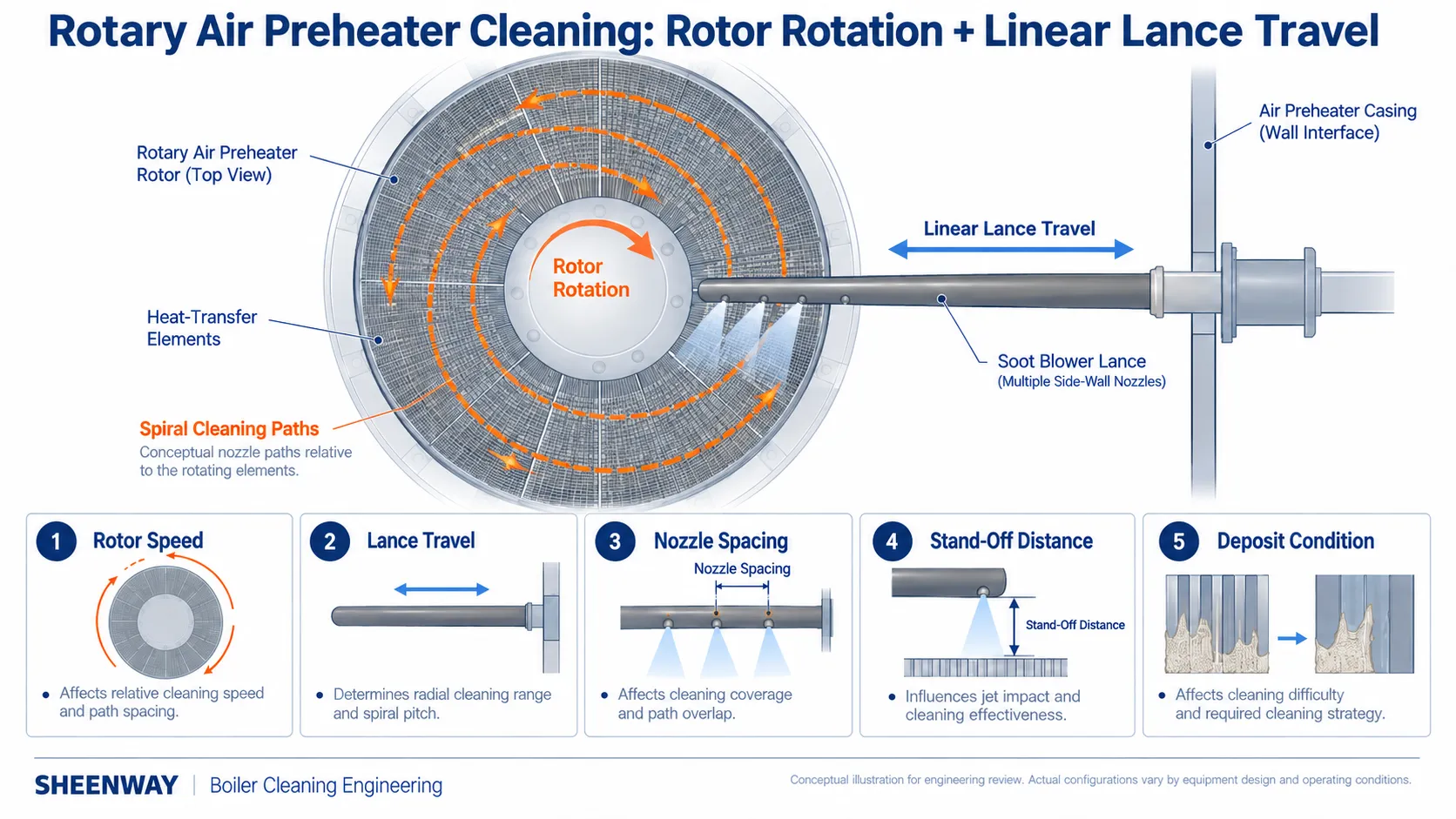
For the SW-SAHS, the lance performs a linear movement while the air-preheater rotor provides the rotational movement.
The lance itself does not need to rotate to generate the required relative cleaning path.
The combined motion can be summarized as:
Linear Lance Travel + Rotor Rotation = Spiral Cleaning Paths
When the rotor rotates at a nearly constant speed and the lance moves radially at a relatively uniform rate, the path traced by a nozzle relative to the rotor can approximate an Archimedean spiral.
SHEENWAY's SW-SAHS documentation describes multiple nozzles working together to generate several spiral cleaning trajectories across the air-preheater heating surface.
However, the existence of a spiral path does not automatically guarantee complete cleaning coverage.
That still depends on nozzle placement, movement speed, jet reach and the dimensions of the heat-transfer area.
3. Rotor Speed and Lance Travel Must Be Considered Together
A key selection issue is the relationship between rotor rotational speed and soot blower lance movement.
If the lance moves radially while the rotor rotates, the distance advanced by the lance during one rotor revolution influences the separation between successive cleaning paths.
Conceptually:
Radial travel per rotor revolution = Lance travel speed ÷ Rotor rotational speed
This relationship is valid when both speeds are expressed in consistent time units and the motion is approximately steady.
For example, if the lance moves farther during each rotor revolution, the resulting spiral turns are more widely separated.
If the lance moves a shorter distance during each revolution, the turns are closer together.
Neither condition is automatically better.
The appropriate spacing depends on the width and effectiveness of the cleaning jet, the number and location of the nozzles and the geometry of the air-preheater heating elements.
This is why the SW-SAHS documentation does not provide a single universal lance travel speed.
The movement speed and mechanical stroke are determined according to the actual installation requirements.
4. Nozzle Quantity and Spacing Determine Coverage
Nozzle configuration is one of the most important design variables for a rotary air preheater soot blower.
The nozzle arrangement must work with the moving lance and rotating heating surface.
SHEENWAY specifies that the nozzle number, diameter and spacing of the SW-SAHS are designed according to the individual air-preheater arrangement.
The engineering objective is to establish the required cleaning coverage across the target heating surface.
Several factors must be considered together:
Nozzle quantity
The number of openings influences how cleaning energy is distributed across the available area.
Nozzle spacing
The distance between adjacent nozzle positions affects overlap and coverage along the lance.
Nozzle orientation
The direction of each jet determines how cleaning energy is applied to the relevant heating-element face.
Lance travel
The moving lance changes the radial position of the nozzle paths.
Rotor speed
The rotation of the heat-transfer matrix determines how the cleaning paths develop over time.
An unsuitable combination may produce excessive overlap in one region and insufficient coverage in another.
Therefore, a larger number of nozzles is not automatically evidence of a better cleaning system.
The correct arrangement is the one matched to the required cleaning area and operating conditions.
5. Why Stand-Off Distance Matters
The distance between the nozzle opening and the heat-transfer surface is another important parameter.
A cleaning jet spreads as it travels away from the nozzle.
This means its spatial coverage and local impact characteristics change with distance.
A nozzle positioned closer to the heat-transfer surface may create a more concentrated local action.
A greater distance can increase the width of the jet footprint, but does not necessarily increase the cleaning force available at the target.
For this reason, wider jet coverage should not be confused with better cleaning effectiveness.
The SW-SAHS product documentation includes illustrative nozzle-distance and coverage-width examples, but those examples belong to the referenced geometry and should not be transferred directly to another air preheater.
During project design, the stand-off dimension must also be defined against the correct physical reference.
A distance measured to a sector plate is not automatically identical to the distance from the nozzle to the relevant heat-transfer element face.
The drawings and measurement references must therefore be confirmed before finalizing nozzle positions.
6. Cleaning Intensity Must Respect the Heat-Transfer Elements
A rotary regenerative air preheater commonly contains thin corrugated heat-transfer plates assembled into element baskets.
These passages provide a large heat-transfer surface area, but the elements also impose mechanical limits on cleaning.
Babcock & Wilcox notes that regenerative air heaters can experience ash accumulation at element inlets and within narrow passages.
Its technical guidance emphasizes directing the cleaning medium appropriately and controlling jet velocity to avoid deformation or vibration-related damage to the thin heat-transfer plates.
This introduces an important design trade-off.
The cleaning medium must have sufficient energy to dislodge deposits, but excessive or poorly directed jet impact may damage the equipment being cleaned.
Selection should therefore consider:
- blowing-medium pressure and available flow;
- nozzle geometry;
- distance to the element face;
- the condition of the heating elements;
- and the nature of the accumulated deposits.
Simply selecting the highest available pressure is not a sound engineering strategy.
7. Deposit Characteristics Can Change the Required Solution
Not all air-preheater deposits respond to cleaning in the same way.
Loose fly ash may be relatively easy to dislodge.
Other deposits can become more strongly attached because of moisture, chemical reactions or long-term accumulation.
The cold end of a rotary air preheater is particularly important because temperatures may approach conditions that promote condensation and deposition.
B&W identifies moisture associated with flue-gas dew-point condensation as a contributor to cold-end fouling.
It also notes that ammonia-related salt deposits may contribute to fouling when selective catalytic reduction equipment is installed upstream.
These deposits can behave differently from loose, dry fly ash.
A soot blower that performs adequately against dry particulate deposits may be less effective against strongly bonded or sticky material.
Before changing nozzle size or increasing the blowing frequency, operators should consider whether the deposit mechanism itself has changed.
For difficult deposits, a supplementary or alternative cleaning method may need to be evaluated under the air-preheater manufacturer's requirements.
The SW-SAHS should not be presented as a universal solution for every type of chemical or strongly bonded deposit.
8. Steam or Compressed Air: What Must Be Confirmed?
The SW-SAHS can use steam or compressed air as its cleaning medium.
The appropriate choice depends on the site's available utilities and the conditions required by the cleaning design.
For steam applications, relevant considerations include pressure, flow, steam condition, drainage and the supply arrangement.
For compressed-air applications, pressure, flow, air condition and supply capacity must be confirmed.
The current SHEENWAY SW-SAHS documentation lists approximately 1.5 MPa as a reference blowing pressure.
This is a product reference value, not a universal pressure recommendation for every rotary air preheater.
Final pressure and flow must be compatible with the nozzle arrangement, air-preheater elements and actual deposit conditions.
Where the cleaning medium or supply system changes during a retrofit, valve, piping, sealing and control compatibility should also be reviewed.
9. Hot-End and Cold-End Cleaning Requirements May Differ
A rotary air preheater may experience different deposit conditions at different axial levels.
The hot-end and cold-end element sections do not necessarily face identical temperatures, ash behavior or cleaning requirements.
Consequently, the appropriate cleaning location and cleaning-medium conditions may differ.
Some air-preheater installations use cleaning equipment at more than one location, while others employ different configurations based on the specific rotor and deposit conditions.
The selection should consider where deposits are forming and which surface must be reached.
The presence of a soot blower at one end should not automatically be taken as evidence that all deposits throughout the rotor are being effectively removed.
Actual cleaning coverage and penetration must be established for the intended application.
10. SW-SAHS Reference Specifications
SHEENWAY's SW-SAHS is designed for cleaning rotary air-preheater heating surfaces using steam or compressed air.
Its operating principle is based on linear lance movement combined with rotation of the air-preheater rotor.
The current product documentation provides the following reference information:
| Parameter | SW-SAHS Reference |
|---|---|
| Application | Rotary air preheater |
| Cleaning medium | Steam or compressed air |
| Lance movement | Linear travel, without lance rotation for the stated cleaning principle |
| Mechanical stroke | Determined by project requirements |
| Lance travel speed | Determined by project requirements |
| Nozzle quantity and diameter | Determined by project requirements |
| Reference blowing pressure | Approx. 1.5 MPa |
| Reference effective blowing radius | Approx. 2 m |
| Reference drive motor | ASR-6324 B5, 0.18 kW |
These values should not be interpreted as a fixed design package.
In particular, the required nozzle configuration, travel and cleaning-medium conditions must be confirmed for the specific air-preheater dimensions and service conditions.
The reference blowing radius is not a guarantee of uniform cleaning across that distance.
11. What Information Is Needed Before Selecting an Air Preheater Soot Blower?
A technical inquiry becomes more useful when it includes information about the air preheater itself, not only the existing soot blower.
The following checklist provides a practical starting point.
| Information Required | Engineering Purpose |
|---|---|
| Air-preheater manufacturer and model | Establishes the original equipment configuration |
| Rotor diameter and cleaning-area dimensions | Defines the required coverage |
| Rotor operating speed | Supports cleaning-path assessment |
| Heating-element arrangement | Identifies the target element face and passage geometry |
| Cleaning location | Confirms hot-end, cold-end or other project-specific arrangement |
| Available installation space | Defines mechanical and maintenance constraints |
| Existing lance stroke and travel speed | Supports retrofit compatibility assessment |
| Nozzle positions and spacing | Supports coverage and overlap evaluation |
| Stand-off distance and measurement datum | Determines the actual jet-to-target geometry |
| Deposit type and location | Helps assess cleaning-method suitability |
| Cleaning-medium pressure and flow | Establishes available service conditions |
| Drawings and control requirements | Supports mechanical and electrical compatibility review |
Not every project will require exactly the same documentation.
However, these inputs provide a more reliable selection basis than specifying only the desired blowing pressure or lance length.
12. Retrofit Projects: Why the Existing Soot Blower Cannot Always Be Copied
For an existing rotary air preheater, the replacement project may begin with the original soot blower's dimensions and model number.
But the previous installation should not be assumed optimal simply because it is already operating.
If the plant has experienced persistent plugging, incomplete cleaning or abnormal element damage, the engineering review should identify whether the issue is related to:
nozzle distribution, cleaning distance, lance movement, medium conditions, deposit chemistry or equipment deterioration.
A replacement with identical dimensions may reproduce the original limitation.
Conversely, changing nozzle geometry or travel speed without evaluating the cleaning paths may introduce new coverage problems.
A successful retrofit must therefore preserve the required mechanical and control interfaces while verifying the intended cleaning function.
13. How Should Cleaning Performance Be Evaluated?
Commissioning a rotary air-preheater soot blower should include more than checking whether the lance travels correctly.
Mechanical operation is necessary, but it does not by itself demonstrate effective cleaning.
Where instrumentation and operating conditions permit, performance assessment can consider:
- pressure-drop trends across the air preheater under comparable operating conditions;
- relevant inlet and outlet temperature trends;
- the response to cleaning cycles;
- observations from planned inspections;
- and evidence of element erosion, distortion or persistent plugging.
These observations must be interpreted in the context of boiler load, flue-gas flow, air leakage and other operating changes.
For example, air-preheater pressure drop may change because of gas flow as well as deposits.
Likewise, a change in outlet temperature is not proof of soot blower performance without considering the wider heat-transfer and operating conditions.
The objective is to evaluate whether the cleaning system performs its intended function—not merely whether the machine completes its stroke.
Conclusion
Selecting a rotary air-preheater soot blower requires an understanding of the relative movement between the cleaning equipment and the rotating heat-transfer matrix.
For the SHEENWAY SW-SAHS, the lance travels linearly while the air-preheater rotor rotates, creating spiral cleaning paths across the target surface.
The final cleaning coverage depends on the interaction between rotor speed, lance travel, nozzle placement, stand-off distance and cleaning-medium conditions.
Equally important, the cleaning strategy must reflect the characteristics of the deposits and the mechanical limits of the heat-transfer elements.
Therefore, an air-preheater soot blower should not be chosen by pressure, stroke or nozzle quantity alone.
The correct selection begins with the geometry and operating conditions of the air preheater—and works backward to the required cleaning arrangement.
For new installations and retrofit projects, SHEENWAY can review the available air-preheater drawings, operating conditions and cleaning requirements to assess an appropriate SW-SAHS configuration.
More from Sheenway
Continue Reading
Retractable Boiler Temperature Probe: Why It Matters During Boiler Startup
During boiler startup, furnace exit gas temperatures can rise before sufficient steam cooling is established in certain heating surfaces. A retractable boiler temperature probe positions a thermocouple in the gas path to provide temperature information for operating decisions. This guide explains the working principle, startup applications, measurement limitations and selection requirements of the SHEENWAY SW-MTPS.
Read articleRake-Type Soot Blower Design for SCR: Nozzle Layout, Travel and Support
Rake-type soot blowers use non-rotating, axially moving cleaning assemblies to direct steam or compressed air toward SCR catalysts and other structured surfaces. This guide explains nozzle layout, travel, support and guide arrangements, cleaning-medium conditions and the engineering checks required before selecting or replacing a rake-type soot blower.
Read articleMulti-Medium Retractable Soot Blowers: When Steam Alone Is Not Enough
Steam soot blowing is effective for many boiler cleaning applications, but certain gypsum, salt and strongly bonded deposits may require additional cleaning methods. This guide explains how multi-medium retractable soot blowers combine different cleaning options, when water washing may be considered, and how engineers select an appropriate solution for gas-gas heaters and air preheaters.
Read article