
Fixed Rotary Soot Blower: When Is It the Right Cleaning Solution?
A fixed rotary soot blower keeps its blowing element inside the flue-gas path and cleans by rotation rather than axial travel. This article explains where fixed rotary designs are suitable, how cleaning arc, deposit condition, temperature, support and medium parameters affect selection, and when a retractable soot blower may be more appropriate.
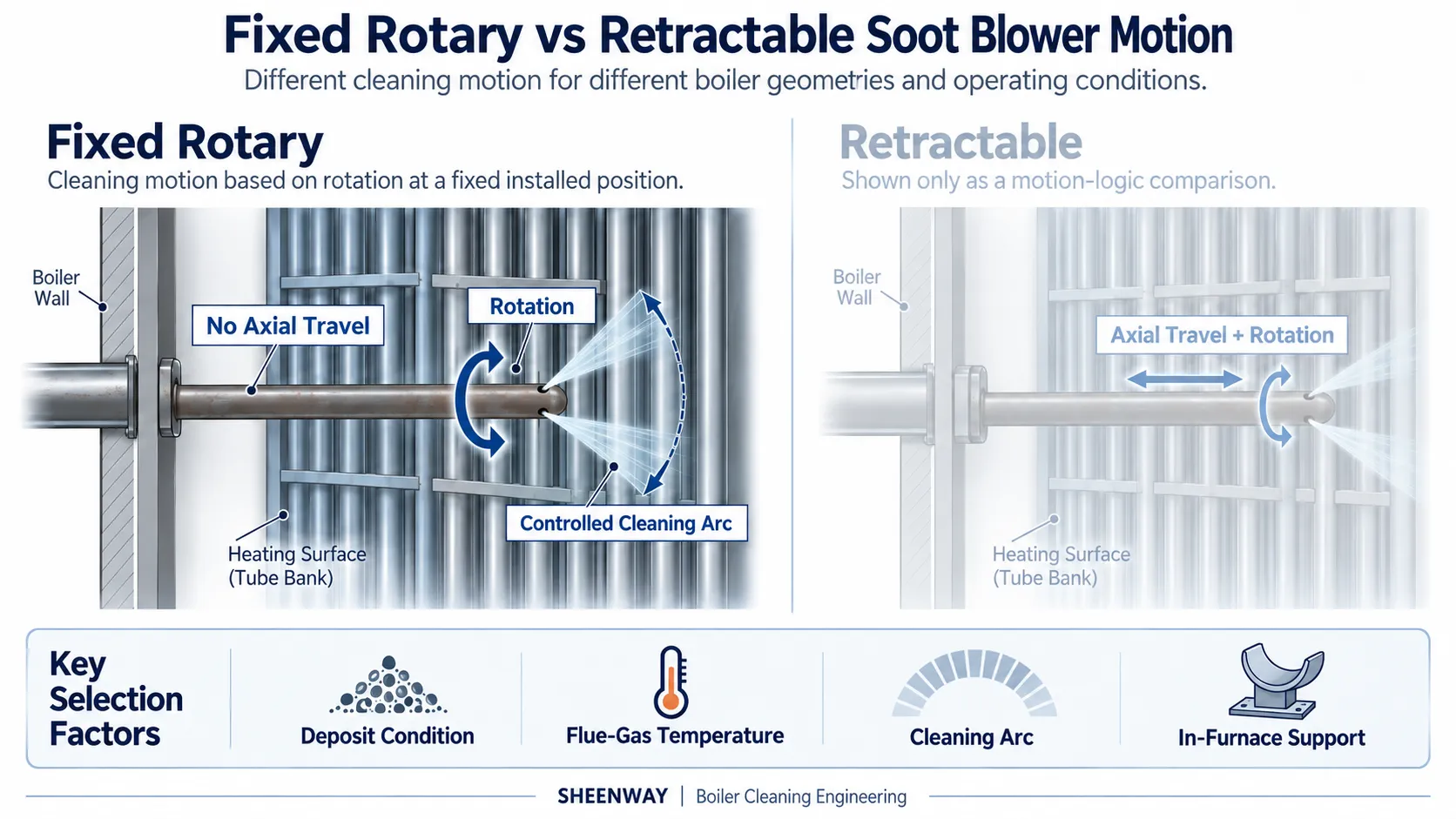
Fixed Rotary Soot Blower: When Is It the Right Cleaning Solution?
Not every boiler heating surface requires a soot blower that travels several meters into and out of the boiler.
In some applications, the cleaning surface is already accessible from a fixed blowing element. The deposits are manageable with rotational cleaning, and the local flue-gas environment allows the blowing tube to remain inside the gas path during normal operation.
In these cases, a fixed rotary soot blower can be a practical solution.
Its defining characteristic is simple:
the blowing element does not travel axially through the boiler. It remains in position and rotates during the cleaning cycle.
That difference affects equipment size, cleaning geometry, temperature exposure, support requirements and the type of deposit the system is expected to remove.
The correct question is therefore not:
“Is a fixed rotary soot blower simpler than a retractable soot blower?”
A better question is:
“Can the required heating surface be cleaned effectively without axial lance travel?”
What Is a Fixed Rotary Soot Blower?
A fixed rotary soot blower uses a blowing tube installed permanently in the flue-gas path.
During a cleaning cycle, steam or compressed air is supplied through the tube while the blowing element rotates.
No long insertion or retraction stroke is required.
For SHEENWAY's SW-SGRS, rotation is motor-driven. A cam controls the blowing arc and valve operation, while the control system determines whether the equipment performs one or two cleaning rotations. The valve also contains a pressure-regulating arrangement that allows the nozzle outlet pressure to be adjusted according to the cleaning location.
This creates a cleaning system whose basic motion can be summarized as:
fixed axial position + controlled rotation + directed jet cleaning.
That is fundamentally different from a long retractable soot blower, where the lance must both travel and rotate to reach a deep tube bank.
Where Are Fixed Rotary Soot Blowers Typically Used?
SHEENWAY currently positions the SW-SGRS for applications including:
- pipeline heating surfaces;
- low-temperature reheaters;
- economizers;
- and industrial boilers. Sheenway_Soot_Blower_Product_Ca…
The wider industry follows a similar application logic.
Babcock & Wilcox notes that fixed-position soot blowers can be used in convection areas where deposits are dusty or relatively loosely attached.
Clyde Bergemann's rotating-element soot blower is likewise used on convection surfaces, reheaters, economizers and fired-heater convection sections where its permanently installed rotating element can provide the required cleaning coverage.
The common principle is not a particular boiler name.
It is this:
the surface must be accessible from a blowing element that does not need to move axially.
Why Would a Boiler Use a Fixed Element Instead of a Retractable Lance?
A retractable soot blower exists because the cleaning element must reach into the boiler and then leave the hot gas path after cleaning.
If neither requirement is necessary, axial travel may provide little additional benefit.
A fixed rotary design removes the long travelling motion from the cleaning process.
This can provide a more compact mechanical arrangement and avoids the need for a long external travel path behind the boiler wall.
But this advantage comes with an important trade-off:
the blowing tube remains inside the flue-gas environment continuously.
That makes temperature, corrosion environment and support conditions more important.
The choice is therefore a structural trade-off:
less external travel versus continuous in-furnace exposure.
Deposit Condition Is One of the First Selection Questions
A fixed rotary soot blower should not be selected simply because there is enough room to install one.
The nature of the deposit matters.
B&W's boiler-cleaning guidance specifically states that fixed-position soot blowers may be used where deposits in the relevant convection region are dusty or loosely adhered. Where ash is more strongly compacted, a different cleaning arrangement may be required.
This does not mean that fixed rotary soot blowers are restricted to one exact deposit type.
It means that cleaning energy and geometry need to match the actual fouling problem.
An engineering review should therefore ask:
Is the deposit primarily loose fly ash?
Is there hard or sintered buildup?
How strongly is the deposit bonded to the heating surface?
Can the fixed nozzle path actually reach the fouled region?
If the required cleaning cannot be achieved from the fixed position, simply increasing pressure may not solve the underlying geometry problem.
Temperature Must Be Checked Carefully
The most important structural consequence of a fixed rotary design is that the blowing element stays inside the flue-gas path.
This means the element experiences the local environment even when it is not actively soot blowing.
Temperature capability therefore depends on:
- blowing-element material;
- support design;
- actual gas temperature;
- duration of exposure;
- corrosion conditions;
- and the specific equipment design.
This is an area where generic industry numbers can be misleading.
For example, Clyde Bergemann specifies its DB rotating-element soot blower for applications with flue-gas temperatures below 500°C.
That does not mean that 500°C is the universal maximum temperature of every fixed rotary soot blower.
Therefore, the correct engineering approach is:
confirm the allowable temperature of the actual product for the actual installation rather than assigning the category a universal temperature limit.
Cleaning Arc Is a Design Parameter
A rotating soot blower does not necessarily need to blow through a complete 360° circle.
The required cleaning area may occupy only part of the circumference.
For the SW-SGRS, the current specified blowing-angle range is 90° to 335°. The blowing arc is controlled mechanically by the cam arrangement.
This is useful because cleaning energy can be directed toward the region that actually requires cleaning rather than automatically applying it around the entire circumference.
The blowing arc should therefore be selected from the actual heating-surface geometry.
Relevant questions include:
Where are the target tubes relative to the lance?
Which directions should receive the cleaning jet?
Are there boiler surfaces that should not receive direct jet impingement?
What overlap is needed between adjacent cleaning zones?
These are layout questions, not simply equipment settings.
Rotation Determines the Cleaning Path
With no axial travel, the final cleaning pattern is generated mainly by:
nozzle location + nozzle orientation + rotational motion + selected cleaning arc.
The current SW-SGRS reference rotational speed is 2.5 r/min, with one or two cleaning cycles per operation depending on requirements.
Those values should be understood as product reference parameters, not a universal rule for fixed rotary soot blowers.
The engineering objective is to create sufficient coverage over the target heating surface.
Running additional rotations is not automatically better if the deposit has already been removed or if the cleaning path itself does not reach the intended area.
Pressure Must Match the Application
The SW-SGRS can use steam or compressed air as its blowing medium.
Its current reference pressure range is 0.6–1.5 MPa.
However, a pressure value should never be considered independently from the rest of the cleaning system.
Cleaning effectiveness also depends on:
- nozzle geometry;
- available medium flow;
- distance to the heating surface;
- deposit strength;
- and the cleaning trajectory.
The SW-SGRS valve includes a pressure-regulating structure specifically because different cleaning locations may require different nozzle outlet conditions.
The goal is therefore not maximum pressure.
It is:
sufficient cleaning energy for the actual deposit and geometry.
In-Furnace Support Is a Functional Requirement
A fixed blowing element remains inside the boiler continuously.
If the tube has significant length, it must remain mechanically stable while exposed to:
- self-weight;
- temperature;
- gas flow;
- repeated rotation;
- and the cleaning reaction forces associated with operation.
For this reason, the SW-SGRS product documentation specifically lists an in-furnace support for the soot-blowing gun barrel among its main components.
Clyde's rotating-element design follows the same general engineering principle, using internal support arrangements for the permanently installed blowing element.
Support should therefore be treated as part of the soot blower design—not as an accessory that can be ignored after the machine is selected.
For retrofit projects, the condition and position of existing supports should also be checked before reusing them.
Fixed Rotary vs Long Retractable: What Is the Real Difference?
The most useful comparison is not simply “fixed” versus “moving.”
It is the relationship between the required cleaning zone and the environment around the lance.
| Selection Factor | Fixed Rotary | Long Retractable |
|---|---|---|
| Axial movement | None during cleaning | Lance travels into and out of boiler |
| Rotation | Yes | Typically combined with travel |
| Element during standby | Remains in flue-gas path | Retracted from active cleaning region |
| External travel space | Relatively compact | Requires space for lance travel |
| Temperature exposure | Continuous for in-furnace element | Reduced after retraction |
| Best suited when | Target can be reached from fixed position | Deep tube banks require lance penetration |
| Cleaning geometry | Controlled mainly by nozzle layout and rotation | Controlled by nozzle layout, rotation and axial travel |
| Support requirement | Important for permanently installed element | Depends on lance and system design |
This is a design comparison, not a universal performance ranking.
When Is a Fixed Rotary Soot Blower a Good Candidate?
A fixed rotary design becomes worth considering when several conditions align.
The target heating surface can be reached effectively from a fixed axial location.
The deposit can be removed by the available rotational cleaning pattern.
The in-furnace blowing element can tolerate the local operating environment.
Adequate support can be provided.
The required cleaning arc can be defined without unwanted jet impingement.
Steam or compressed air is available at suitable pressure and flow.
And the external installation benefits from not requiring a long retracting structure.
When these conditions are satisfied, a fixed rotary design can provide the required cleaning function without adding an axial travel mechanism that the application does not need.
When Is It Probably the Wrong Choice?
A fixed rotary soot blower may be inappropriate when the required cleaning zone cannot be reached from one fixed lance position.
Examples include deep convective tube banks where the cleaning jet needs to move through the bank to maintain coverage.
It should also be reconsidered if:
the local temperature exceeds the approved limit of the selected product;
continuous lance exposure creates unacceptable material or corrosion risk;
the deposit requires a different cleaning mechanism;
adequate in-furnace support cannot be provided;
or the target geometry requires axial positioning of the nozzles.
In these conditions, a long retractable, semi-retractable, rake-type or another cleaning technology may be more appropriate.
Typical SW-SGRS Reference Parameters
The current SHEENWAY SW-SGRS documentation lists the following reference values:
| Parameter | SW-SGRS Reference |
|---|---|
| Soot blowing angle | 90°–335° |
| Rotational speed | 2.5 r/min |
| Cleaning cycles | 1 or 2, as required |
| Maximum blowing radius | Approx. 1–1.5 m |
| Cleaning medium | Steam or compressed air |
| Medium pressure | 0.6–1.5 MPa |
| Medium consumption | 30–100 kg/min |
| Motor | YSR-6324 B5, 180 W |
| Approximate equipment weight | 75 kg |
These are product reference values and should not replace project-specific engineering confirmation.
Before selection, SHEENWAY specifically recommends confirming the cleaning arc, mounting interface, medium pressure and flow, cleaning-cycle requirement and in-furnace support.
Maintenance Logic Is Also Different
Because the blowing element remains inside the gas path, inspection of the element itself becomes important during boiler maintenance.
EPRI recommends periodic inspection of sootblower components and specifically notes element inspection for rotary soot blowers during boiler overhaul. It also emphasizes preventive attention to packing, lubrication, seals, purge arrangements and other components exposed to heat, dirt and corrosive gases.
This means a fixed rotary soot blower should not be interpreted as “no travel mechanism, therefore no maintenance.”
Its maintenance priorities are simply different.
Particular attention should be given to:
rotational mechanism condition,
valve operation,
in-furnace element condition,
supports,
sealing,
and evidence of corrosion or thermal deterioration.
What Information Should Be Confirmed Before Selection?
A useful RFQ for a fixed rotary soot blower should include:
Boiler location
Economizer, low-temperature reheater, industrial boiler convection section or another area.
Target heating-surface geometry
Tube arrangement and the position of the surface relative to the blowing element.
Deposit characteristics
Loose ash, compacted fouling or another type of deposit.
Flue-gas temperature
Especially the maximum expected temperature at the installed blowing element.
Required cleaning arc
Which angular region actually needs cleaning?
Required cleaning radius
How far is the target surface from the lance?
Available steam or compressed air
Pressure and flow at the soot blower.
Installation interface
Wall box, mounting arrangement and available external space.
In-furnace support
Location and structural arrangement.
Operating requirement
Required cleaning cycles and control interface.
This information allows the fixed rotary concept to be evaluated as an engineering solution rather than chosen only because it is mechanically compact.
Conclusion
A fixed rotary soot blower is not simply a cheaper or shorter version of a retractable soot blower.
It is a different cleaning architecture.
The blowing element remains inside the flue-gas path and produces its cleaning pattern through controlled rotation rather than axial travel.
This makes it suitable where the target surface can be reached from a fixed position, the deposits are compatible with the available cleaning energy, the element can tolerate continuous furnace exposure and adequate in-furnace support can be provided.
SHEENWAY's SW-SGRS uses motor-driven rotation, cam-controlled cleaning arc and adjustable medium pressure, with current applications including pipeline heating surfaces, low-temperature reheaters, economizers and industrial boilers.
The selection principle is therefore straightforward:
Use a fixed rotary soot blower when rotation alone can create the required cleaning coverage.
If the cleaning zone requires the nozzle to travel deep through a tube bank, a retractable design may be the more appropriate architecture.
More from Sheenway
Continue Reading
Retractable Boiler Temperature Probe: Why It Matters During Boiler Startup
During boiler startup, furnace exit gas temperatures can rise before sufficient steam cooling is established in certain heating surfaces. A retractable boiler temperature probe positions a thermocouple in the gas path to provide temperature information for operating decisions. This guide explains the working principle, startup applications, measurement limitations and selection requirements of the SHEENWAY SW-MTPS.
Read articleRake-Type Soot Blower Design for SCR: Nozzle Layout, Travel and Support
Rake-type soot blowers use non-rotating, axially moving cleaning assemblies to direct steam or compressed air toward SCR catalysts and other structured surfaces. This guide explains nozzle layout, travel, support and guide arrangements, cleaning-medium conditions and the engineering checks required before selecting or replacing a rake-type soot blower.
Read articleMulti-Medium Retractable Soot Blowers: When Steam Alone Is Not Enough
Steam soot blowing is effective for many boiler cleaning applications, but certain gypsum, salt and strongly bonded deposits may require additional cleaning methods. This guide explains how multi-medium retractable soot blowers combine different cleaning options, when water washing may be considered, and how engineers select an appropriate solution for gas-gas heaters and air preheaters.
Read article