
Tackling Sticky Ash: Advanced Sootblower Solutions for Biomass and WtE Boilers
Biomass and Waste-to-Energy (WtE) boilers face severe slagging and sticky ash issues due to high alkali content in fuels. Discover how specialized sootblowing strategies can prevent tube corrosion, maximize heat transfer, and avoid unplanned shutdowns.
Introduction: The Unique Challenge of Renewable Fuels
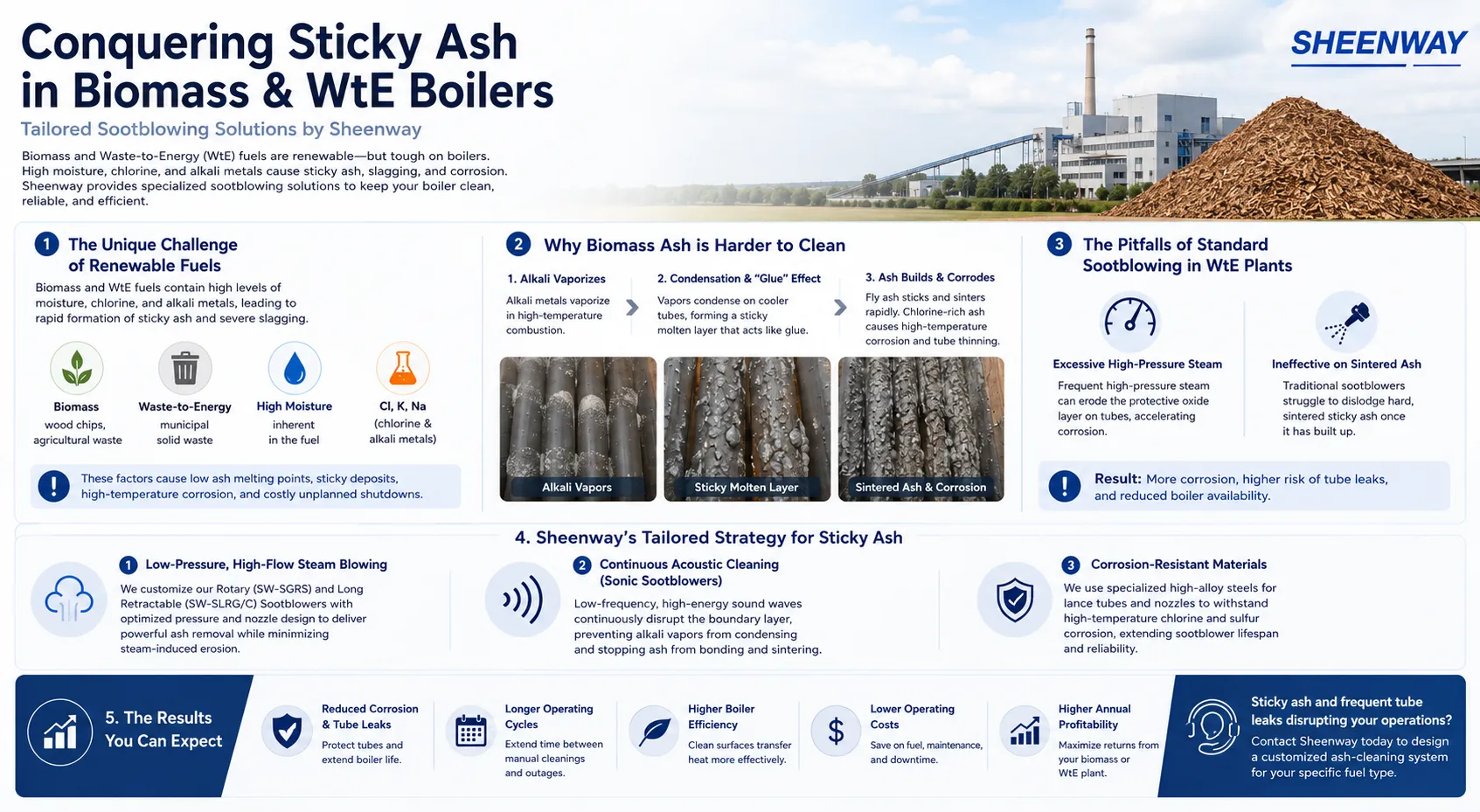
The shift towards renewable energy has driven massive growth in Biomass and Waste-to-Energy (WtE) power plants. However, while these fuels are environmentally friendly, they represent an absolute nightmare for boiler operators. Unlike traditional coal, biomass (such as agricultural waste, wood chips) and municipal solid waste contain high levels of moisture, chlorine, and alkali metals (like potassium and sodium). This unique chemical composition leads to the rapid formation of sticky ash and severe slagging, which severely compromises boiler efficiency and forces frequent, costly unplanned shutdowns.
Why Biomass Ash is Harder to Clean
The core issue lies in the low melting point of the ash. During combustion, the alkali metals vaporize and then condense on the relatively cooler convective heating surfaces (superheaters and economizers).
- The "Glue" Effect: This condensation forms a sticky, molten layer. Fly ash particles then crash into this layer and stick, rapidly building up a hard, sintered deposit.
- High-Temperature Corrosion: The accumulation of chlorine-rich ash directly attacks the boiler tubes. If left uncleaned, this acidic environment accelerates tube thinning, leading to catastrophic tube leaks.
The Pitfalls of Standard Sootblowing in WtE Plants
Simply running traditional high-pressure steam sootblowers more frequently is not the answer. In a WtE or Biomass boiler, excessive high-pressure steam can easily erode the protective oxide layer on the tubes, accelerating corrosion. Furthermore, traditional sootblowers often struggle to dislodge ash once it has severely sintered.
Sheenway’s Tailored Strategy for Sticky Ash
To conquer the harsh environments of Biomass and WtE boilers, Sheenway Power has developed specialized cleaning protocols that focus on prevention and precise removal:
- Low-Pressure, High-Flow Steam Blowing: We customize our Rotary (SW-SGRS) and Long Retractable (SW-SLRG/C) Sootblowers to operate with optimized pressure and nozzle geometries. This ensures that the kinetic energy is sufficient to shear off the sticky ash without causing steam-induced erosion to the vulnerable boiler tubes.
- Continuous Acoustic Cleaning (Sonic Sootblowers): The best way to deal with sticky ash is to stop it from bonding in the first place. By deploying Sheenway Sonic Sootblowers, low-frequency, high-energy sound waves continuously disrupt the boundary layer, preventing alkali vapors from condensing and stopping the ash before it sinters.
- Corrosion-Resistant Materials: For WtE applications, Sheenway manufactures lance tubes and nozzles using specialized high-alloy steels that withstand high-temperature chlorine and sulfur corrosion, drastically extending the lifespan of the sootblower itself.
Conclusion
Operating a Biomass or WtE plant efficiently requires acknowledging that fuel properties have changed, and cleaning methods must evolve accordingly. By implementing a targeted, hybrid sootblowing strategy, plant managers can significantly reduce boiler tube corrosion, extend operating cycles between manual cleanings, and achieve higher annual profitability.
Are sticky ash and frequent tube leaks disrupting your Biomass boiler operations? Contact Sheenway Power today to design a customized ash-cleaning system for your specific fuel type.