
Soot Blower Retrofit Compatibility: What to Check Before Replacement
Replacing an existing soot blower requires more than matching the original model or overall dimensions. Mechanical interfaces, lance geometry, cleaning coverage, steam or air supply, sealing, drive systems and electrical controls must all be reviewed. This guide explains the key engineering checks for soot blower retrofits and cross-brand replacement projects.
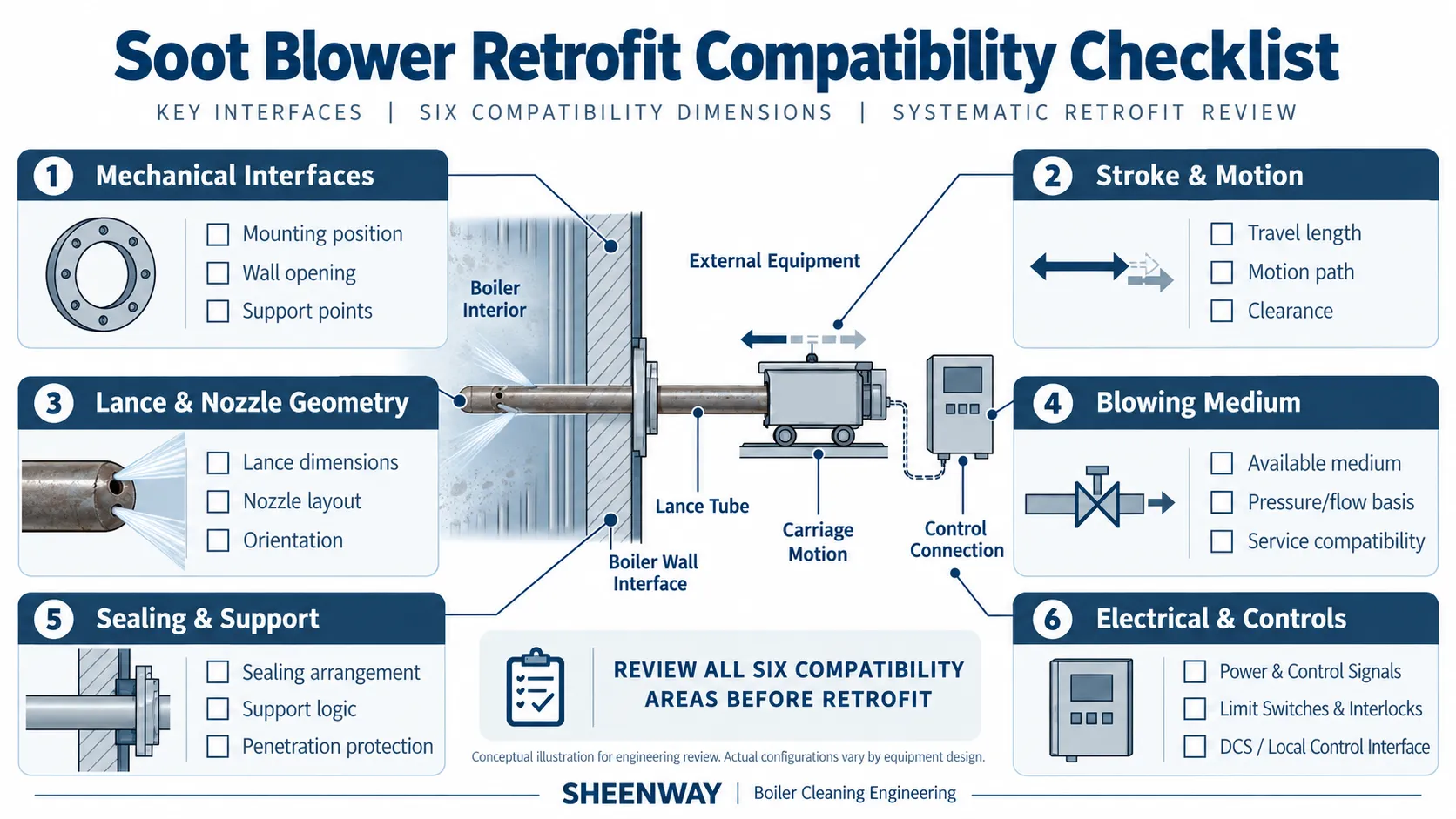
Replacing an existing soot blower may appear straightforward: identify the installed model, purchase a replacement unit and connect it to the boiler.
In practice, a soot blower that fits the available installation space is not necessarily compatible with the existing cleaning system.
A soot blower is not simply a mechanical assembly. It is part of an integrated system that delivers cleaning energy to a specific area of the boiler.
Its operation depends on the relationship between the lance, feed tube, nozzle configuration, valve, drive system, boiler wall interface and control equipment.
For this reason, replacing an existing soot blower—particularly with equipment from a different manufacturer—requires more than checking the overall length or original model number.
A reliable retrofit should preserve the required cleaning function while ensuring that the replacement can operate safely within the existing mechanical, thermal and control arrangements.
This article explains the key engineering checks that should be completed before specifying a replacement soot blower.
1. Define the Scope of the Replacement
Before comparing dimensions, determine what is actually being replaced.
There are several possible approaches.
Component replacement involves replacing individual parts such as a lance tube, feed tube, valve, sealing component or carriage assembly while retaining most of the original machine.
Engineered equipment replacement involves installing a replacement soot blower intended to perform the same cleaning function as the existing unit, subject to compatibility verification.
System retrofit or modernization may involve changing equipment configuration, cleaning performance requirements, drive arrangements, controls or other parts of the soot-blowing system.
These approaches should not be treated as interchangeable.
A replacement lance tube may require detailed nozzle and interface verification, while replacing an entire soot blower also introduces mounting, drive, support and control-system requirements.
The first question should therefore be:
Which components will remain, which will be replaced, and which functions must be preserved?
2. Identify the Original Equipment Correctly
The original soot blower manufacturer and model provide an important starting point.
Useful information includes the manufacturer's name, equipment model, serial number, plant equipment tag, original drawings and available maintenance records.
However, an original model designation alone is not always sufficient.
The equipment may have been modified during previous maintenance or retrofit work. Replacement parts may have been installed to a revised design. Site operating conditions may also have changed.
The technical review should therefore establish both:
the original design configuration
and
the actual installed configuration.
For a cross-brand replacement, this distinction is particularly important.
A replacement proposal should be developed from verified equipment information, rather than assuming interchangeability solely because two machines belong to the same soot blower category.
3. Check Mechanical Mounting Interfaces
Mechanical compatibility begins at the boiler wall and the supporting structure.
Depending on the soot blower design, the relevant dimensions may include mounting-hole positions, flange geometry, equipment centerline, support points, wall-box dimensions and available maintenance clearance.
These details determine whether the replacement can be installed without interference or unapproved modifications.
The boiler wall box deserves particular attention.
As described in Babcock & Wilcox's sootblower technical reference, the wall box provides an interface at the boiler opening, with functions that can include support and limiting flue-gas leakage.
A replacement must therefore be checked not only for physical attachment but also for the sealing and support functions associated with the existing interface.
For retrofit projects, the engineering review should establish whether existing mounting features can be retained or require an approved modification.
4. Verify Stroke, Travel and Motion
For a retractable soot blower, the mechanical stroke determines how far the lance moves through its operating cycle.
An incorrect stroke can alter the position of the nozzles relative to the heating surfaces.
The replacement review should confirm:
- required forward and retraction travel;
- fully retracted and fully extended positions;
- travel speed;
- rotational speed, where applicable;
- travel limits and stopping positions;
- and the relationship between movement and cleaning-medium admission.
Different soot blower types also use different movement principles.
A long retractable soot blower generally combines axial travel and rotation.
A fixed rotary soot blower rotates without long axial travel.
A rake-type soot blower may use a non-rotating directional cleaning arrangement.
These movement characteristics cannot be treated as minor variations if the replacement must reproduce the original cleaning function.
For SHEENWAY's SW-SLRG Series, stroke, travel speed and rotational speed are engineering parameters determined according to the boiler application rather than universal values.
5. Check Lance, Feed Tube and Nozzle Compatibility
The lance tube and feed tube are separate functional components.
In a typical retractable soot blower arrangement, the feed tube supplies the cleaning medium to the moving lance assembly.
The lance then delivers the medium to the intended cleaning area through its nozzle openings.
The replacement review should consider outside diameter, wall thickness, overall length, material, connection details, sealing interfaces and nozzle geometry.
Nozzle configuration is especially important.
Two lance tubes can have identical nominal dimensions while producing different cleaning patterns because of differences in:
- nozzle quantity;
- opening diameter;
- nozzle position;
- blowing angle;
- and angular orientation.
These differences affect where the cleaning jet reaches the heating surface.
For this reason, the nozzle arrangement should be verified against the original drawing or an approved revised design.
A replacement that is dimensionally interchangeable is not automatically functionally equivalent.
6. Verify Steam or Compressed-Air Conditions
Soot blowers may use steam or compressed air, depending on the equipment design.
A replacement must be compatible with the actual cleaning-medium conditions available at the installation.
The review should address the appropriate operating pressure, available flow, medium temperature, valve characteristics and required connections.
It should also consider the condition of the upstream supply system.
When steam is used, proper warming and condensate drainage are important.
The National Board of Boiler and Pressure Vessel Inspectors warns that wet steam can aggravate boiler-tube damage, particularly where an incorrectly directed soot-blowing jet strikes a tube surface.
This means that a retrofit cannot be evaluated only by matching the nominal steam pressure.
The complete steam-supply and cleaning arrangement may need to be reviewed.
If the replacement requires different medium flow or valve characteristics, those changes must be assessed against the available plant system.
7. Review Valves, Seals and Purge Arrangements
A soot blower valve controls when the cleaning medium enters the equipment.
The associated sealing arrangements help maintain the intended boundaries between the cleaning-medium system, the soot blower and the boiler environment.
Depending on the design, the replacement may involve lift valves, poppet valves, packing, feed-tube seals, wall-box seals or purge-air connections.
These components are not necessarily interchangeable across different manufacturers.
The original and replacement arrangements should be evaluated for sealing method, pressure capability, mechanical connection and operating sequence.
The EPRI Sootblowing Application and Maintenance Guide emphasizes the importance of maintaining packing, pressure seals and purge arrangements. It also identifies corrosive flue-gas backflow as a potential cause of equipment deterioration.
For this reason, a replacement that appears mechanically compatible should not be approved before its sealing and purge functions have been reviewed.
8. Confirm Carriage, Drive and Mechanical Load Requirements
For a retractable soot blower, the carriage assembly provides the mechanical movement needed to position the lance.
The drive arrangement may include an electric motor, reducer, gears, racks, chains or other mechanisms, depending on the design.
Different assemblies can have different movement characteristics and structural loads.
The engineering review should therefore consider:
Carriage travel and guidance
Can the replacement move smoothly through the required path?
Drive compatibility
Does the motor and transmission arrangement produce the required speed and movement?
Support and loading
Are the existing beam, brackets and supports suitable for the replacement equipment?
Mechanical clearances
Can the replacement operate and be maintained without interference?
For some projects, replacing a worn carriage assembly may be sufficient.
For others, the entire supporting and travelling arrangement may need to be reconsidered.
9. Electrical and Control-System Compatibility
Mechanical compatibility is only one part of a successful retrofit.
Modern soot blowers may be connected to local control panels, motor-control equipment, boiler control systems or a distributed control system (DCS).
A replacement unit should not be assumed electrically compatible simply because it uses a motor of similar power.
Relevant checks may include:
- motor voltage, frequency and phase;
- motor starting and protection arrangements;
- limit-switch types and positions;
- position or status feedback;
- valve-actuation sequence;
- forward and reverse operation;
- control wiring and signal requirements;
- and applicable plant interlocks.
The relationship between cleaning-medium admission and lance movement is particularly important.
The replacement must preserve the required operating sequence and protective functions.
If the existing control logic is being modified, the new arrangement should undergo an engineering review and appropriate functional testing before being placed into service.
10. Check Temperature, Materials and Support Conditions
Different boiler locations expose soot blower components to different thermal and chemical environments.
A furnace soot blower, long retractable soot blower, fixed rotary soot blower and SCR rake-type soot blower do not necessarily have identical material or support requirements.
Material selection should therefore be based on the actual application.
Relevant factors include maximum expected flue-gas temperature, duration of exposure, deposit chemistry, mechanical loading and fabrication requirements.
Support geometry must also be considered.
A replacement lance with different length, diameter or material characteristics may behave differently under self-weight and operating temperature.
The engineering review should evaluate the complete support arrangement rather than considering the lance in isolation.
No universal material grade or temperature limit should be assumed for every retrofit.
11. Verify Cleaning Coverage, Not Just Equipment Fit
The purpose of a soot blower is to clean a defined region of the boiler.
A replacement that mounts correctly but delivers the cleaning jet to the wrong area does not meet that objective.
Cleaning coverage depends on the combined relationship between:
nozzle geometry + lance movement + blowing-medium conditions + heating-surface layout.
The replacement should therefore be assessed against the required cleaning region.
For example, changing a nozzle angle can change jet orientation even when the lance dimensions remain unchanged.
Changing travel speed or rotation can change how the jet moves across a tube bank.
Changing blowing pressure or medium flow can alter the cleaning action.
The design review should confirm that the required cleaning function is maintained without creating unacceptable jet impingement or other operating risks.
12. Establish Inspection and Commissioning Requirements
Before a replacement is placed into service, its installation and operation need to be verified.
The detailed procedure should follow the applicable OEM instructions, project specification and plant safety requirements.
Depending on the scope of the retrofit, checks may include:
- dimensional and mounting verification;
- alignment of the lance and boiler opening;
- confirmation of mechanical travel;
- limit-switch and control-function tests;
- valve and sealing checks;
- supply-system readiness;
- and controlled operating verification.
The National Board specifically identifies sootblower alignment as an important pre-start-up consideration. It notes that alignment carried out when equipment is cold must account for thermal expansion during operation.
This means cold installation geometry alone may not fully represent the operating condition.
A retrofit should be considered complete only after the specified inspection and commissioning acceptance criteria have been satisfied.
Soot Blower Retrofit Compatibility Checklist
| Engineering Area | Key Questions |
|---|---|
| Original equipment | Are the manufacturer, model, drawings and installed configuration confirmed? |
| Replacement scope | Is the project replacing one component, a major assembly or the complete machine? |
| Mounting interfaces | Are wall box, flanges, centerline, supports and clearance compatible? |
| Stroke and motion | Are travel, rotation, speed and stopping positions correct? |
| Lance and feed tube | Do the dimensions, materials, connections and sealing interfaces match? |
| Nozzle configuration | Will the intended cleaning coverage and jet orientation be maintained? |
| Cleaning medium | Are pressure, flow, supply connections and medium condition suitable? |
| Valves and seals | Are valve operation, packing, pressure seals and purge arrangements compatible? |
| Drive system | Are carriage, motor, transmission and mechanical loads suitable? |
| Electrical and controls | Are power supply, signals, limit switches and interlocks verified? |
| Operating environment | Are temperature, corrosion conditions and support requirements addressed? |
| Commissioning | Are inspection, functional testing and acceptance criteria defined? |
The checklist is a preliminary engineering review framework. Project-specific equipment may require additional verification.
Replacement Does Not Always Mean a Complete New Soot Blower
One important retrofit decision is whether the entire soot blower actually needs to be replaced.
Some maintenance problems can be addressed by replacing individual components or upgrading selected assemblies.
For example, a project may involve a lance tube, feed tube, sealing component, valve or carriage rather than the complete machine.
Babcock & Wilcox's published aftermarket information identifies replacement parts and performance upgrades for a variety of sootblower components, illustrating that partial replacement and equipment upgrades are established approaches within the industry.
However, the appropriate scope depends on the actual condition and compatibility of the installed system.
Replacing one failed component without identifying the underlying cause may allow the same problem to recur.
Conversely, replacing an entire machine may be unnecessary if the existing structure and operating system remain suitable.
The replacement decision should therefore follow an assessment of equipment condition, required function and available retrofit options.
Cross-Brand Replacement: Engineering Compatibility Comes First
A replacement soot blower does not necessarily have to come from the original equipment manufacturer.
But cross-brand replacement should be treated as an engineered compatibility project.
SHEENWAY supplies customized replacement components for different soot blower brands and configurations, including applications involving Diamond and Clyde Bergemann equipment.
Its technical review process considers original equipment data, dimensional verification, structural comparison and actual operating conditions.
This does not mean that one standard replacement unit fits every model from those manufacturers.
Compatibility must be established for the individual project.
The appropriate objective is not simply to reproduce the appearance of the original soot blower.
It is to verify the mechanical fit, operating conditions, control functions and required cleaning performance of the replacement.
What Should a Buyer Send for a Retrofit Quotation?
A useful technical inquiry should identify the existing soot blower, the proposed replacement scope and the available site information.
Where possible, buyers should provide:
Original equipment details: manufacturer, model, serial number and equipment tag.
Existing drawings: general arrangement, installation interface and relevant component drawings.
Mechanical information: stroke, lance dimensions, wall-box arrangement, supports and maintenance clearance.
Operating conditions: boiler section, flue-gas temperature, cleaning medium, pressure and flow.
Electrical and controls: motor supply, control drawings, feedback devices and interface requirements.
Current problem: the reason replacement is being considered, including any observed mechanical failure or insufficient cleaning.
Required scope: replacement parts, major assembly or complete soot blower.
If some technical details are unavailable, they should be identified as unknown rather than estimated without a basis.
Providing the original drawings together with photographs of the installed equipment is often a useful starting point for engineering review.
Conclusion
Replacing a soot blower is not simply a matter of finding a machine with similar dimensions.
A technically compatible replacement must be evaluated across mechanical interfaces, movement, nozzle geometry, cleaning-medium supply, sealing, drive arrangements, control functions and operating environment.
These systems interact to determine whether the soot blower can perform its intended cleaning function.
For this reason, cross-brand replacement should be treated as an engineering verification process rather than automatic model interchangeability.
SHEENWAY supports replacement and retrofit inquiries through dimensional review, structural comparison and application-specific technical assessment.
For existing installations, buyers can submit the original soot blower model, available drawings, operating conditions and replacement requirements for compatibility review.
The goal is not merely to install a replacement soot blower. It is to maintain the required cleaning function within the actual boiler system.
More from Sheenway
Continue Reading
Retractable Boiler Temperature Probe: Why It Matters During Boiler Startup
During boiler startup, furnace exit gas temperatures can rise before sufficient steam cooling is established in certain heating surfaces. A retractable boiler temperature probe positions a thermocouple in the gas path to provide temperature information for operating decisions. This guide explains the working principle, startup applications, measurement limitations and selection requirements of the SHEENWAY SW-MTPS.
Read articleRake-Type Soot Blower Design for SCR: Nozzle Layout, Travel and Support
Rake-type soot blowers use non-rotating, axially moving cleaning assemblies to direct steam or compressed air toward SCR catalysts and other structured surfaces. This guide explains nozzle layout, travel, support and guide arrangements, cleaning-medium conditions and the engineering checks required before selecting or replacing a rake-type soot blower.
Read articleMulti-Medium Retractable Soot Blowers: When Steam Alone Is Not Enough
Steam soot blowing is effective for many boiler cleaning applications, but certain gypsum, salt and strongly bonded deposits may require additional cleaning methods. This guide explains how multi-medium retractable soot blowers combine different cleaning options, when water washing may be considered, and how engineers select an appropriate solution for gas-gas heaters and air preheaters.
Read article