
Steam Soot Blower vs Sonic Soot Blower: Working Principles, Applications and Selection
Steam soot blowers and sonic soot blowers remove deposits through fundamentally different mechanisms. This guide compares direct high-velocity jet cleaning with acoustic cleaning and explains how deposit characteristics, equipment geometry, utilities and operating conditions influence technology selection.
Steam Soot Blower vs Sonic Soot Blower: Working Principles, Applications and Selection
There is no single cleaning technology that is ideal for every ash deposit or every section of an industrial boiler.
A furnace water wall exposed to slagging, a deep superheater tube bank, an SCR catalyst layer and a dust-collection system all present different cleaning conditions. Deposit strength, equipment geometry, temperature and accessibility can vary significantly from one location to another.
Two commonly discussed approaches are steam soot blowing and sonic soot blowing.
Although both technologies are intended to control deposits during operation, their cleaning mechanisms are fundamentally different.
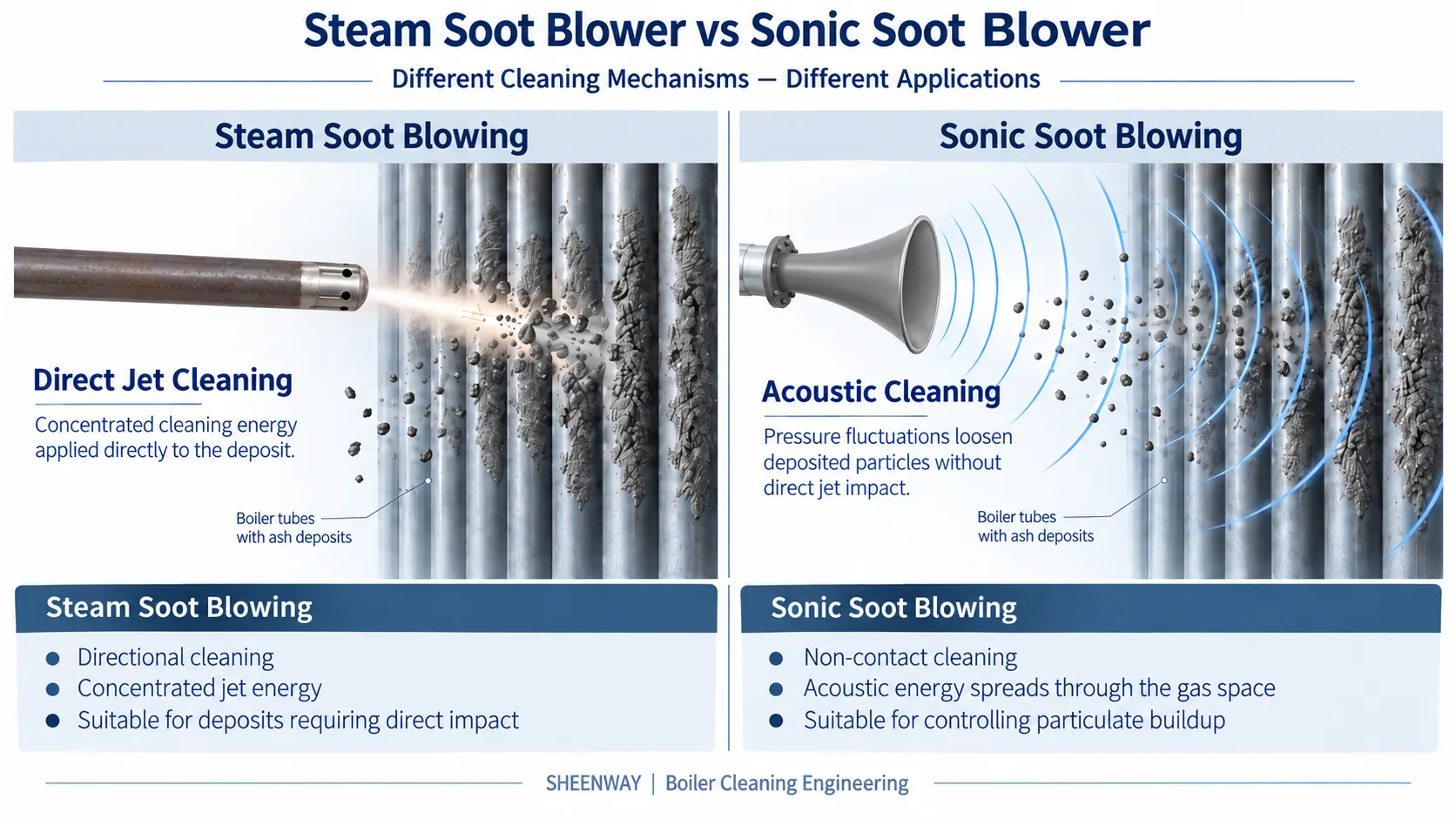
A steam soot blower uses a directional, high-velocity jet to transfer cleaning energy directly to the contaminated surface. A Sonic Soot Blower uses compressed air to generate high-energy acoustic pulses that act on deposited particles without requiring a continuous jet to strike each surface directly.
Understanding that difference is the starting point for selecting the right cleaning technology.
How Does a Steam Soot Blower Clean Deposits?
In a conventional steam soot blowing system, steam is supplied to the soot blower and discharged through one or more openings in the soot blowing lance as a high-velocity jet.
Depending on the equipment type, the lance may rotate, extend into the boiler, remain in a fixed position, or combine rotational and linear movement.
The jet acts directly on deposits attached to the heating surface.
For example, a furnace soot blower can advance into position and perform controlled rotary cleaning around the furnace water wall. Long retractable soot blowers travel deep into superheater, reheater and economizer tube banks while rotating, allowing the cleaning jet to cover a large convective heating-surface area.
SHEENWAY's SW-SLRG Series, for example, is designed for applications including superheaters, reheaters and economizers and can use steam or compressed air as the blowing medium. The actual travel speed, rotational speed, nozzle configuration, medium pressure and flow are determined according to boiler temperature, fuel, ash characteristics and available medium conditions.
The key characteristic of this method is therefore direct jet impact.
How Does a Sonic Soot Blower Work?
A Sonic Soot Blower uses a different mechanism.
Compressed air enters the sound generator and causes the internal diaphragm to deflect. As air moves into the horn and pressure conditions change, the diaphragm rapidly reverses direction and generates a strong pulse. The horn then amplifies this pulse into high-energy sound waves.
These pressure fluctuations propagate through the surrounding gas space and cause deposited particles to vibrate, loosen and separate from each other and from surrounding surfaces.
Once loosened, the material can fall under gravity or be carried away by the gas stream.
Because the sound field can propagate through a volume rather than acting only along a narrow jet trajectory, acoustic cleaning can reach surfaces and gaps that may not lie directly in front of a nozzle.
SHEENWAY classifies this technology as acoustic cleaning, while the equipment itself is standardized as a Sonic Soot Blower. Applications in the current product documentation include boiler tube banks, heat exchangers, SCR reactors, electrostatic precipitators, baghouse filters, hoppers and ventilation ducts.
The Core Difference: Impact Cleaning vs Acoustic Cleaning
The most important distinction is not simply the utility being consumed.
It is the way cleaning energy reaches the deposit.
| Engineering Factor | Steam Soot Blowing | Sonic Soot Blowing |
|---|---|---|
| Main cleaning mechanism | Direct high-velocity jet | Acoustic pressure fluctuations |
| Contact with target area | Directional jet acts on selected surfaces | Sound field propagates through surrounding gas space |
| Typical role | Removal of ash and slag deposits requiring directed cleaning | Loosening and controlling particulate deposits |
| Cleaning pattern | Determined by nozzle direction and soot blower movement | Determined by frequency, acoustic output, equipment geometry and installation position |
| Utility | Typically steam; some mechanical soot blower designs can also use compressed air | Plant compressed air |
| Mechanical configuration | Often includes moving lance, carriage, rotation or retracting mechanism | Current SHEENWAY documentation describes only one moving component in the complete unit |
| Typical applications | Furnace walls, superheaters, reheaters, economizers, air-preheater areas | Boiler tube banks, heat exchangers, SCR, ESP, baghouses, hoppers and ducts |
| Can technologies be combined? | Yes | Yes |
The comparison should therefore not be reduced to the idea that one technology is universally “stronger” or “better.”
The relevant question is:
What type of deposit needs to be controlled, and how can cleaning energy effectively reach it?
Deposit Characteristics Are the First Selection Factor
Deposit strength is one of the most important differences between applications.
Steam-jet soot blowing provides concentrated, directional cleaning energy. This makes it suitable for boiler areas where ash or slag deposits require direct mechanical cleaning.
SHEENWAY furnace soot blower documentation, for example, specifically describes the removal of ash and slag from boiler water walls. The cleaning arc, number of rotations and blowing pressure can be adjusted according to deposit conditions.
Sonic cleaning is based on a different objective.
Rather than relying on a high-velocity jet striking the deposit directly, acoustic energy causes particulate deposits to vibrate and loosen. Current SHEENWAY documentation states that lower-frequency sound is generally effective for dust and particulate deposits, while frequency selection must also consider installation distance, equipment geometry and structural natural frequencies.
This makes acoustic cleaning particularly relevant where deposits can be controlled by preventing them from consolidating into heavier buildup.
Equipment Geometry Can Be Just as Important as Deposit Strength
Boiler cleaning is a three-dimensional access problem.
A steam jet is directional. The soot blower therefore needs an appropriate installation position and cleaning trajectory so that the jet can reach the intended surface.
This is why different mechanical soot blower types exist.
Furnace soot blowers are designed around furnace-wall cleaning. Long retractable soot blowers reach deep convective tube banks. Rake-type soot blowers direct cleaning toward surfaces such as SCR catalyst layers where the geometry requires a different blowing direction.
Sonic cleaning behaves differently because acoustic pressure fluctuations can propagate through the gas space around internal structures.
That does not mean that one Sonic Soot Blower will automatically clean every inaccessible area. The position of the unit, frequency, acoustic output, equipment geometry and structural characteristics still need to be evaluated.
But the propagation mechanism can be useful where direct line-of-sight jet access is difficult.
Frequency Matters in Sonic Cleaning
One of the major engineering parameters for acoustic cleaning is frequency.
In general, lower-frequency sound provides longer-range action and can influence a larger effective cross-section.
However, simply selecting the lowest available frequency is not a sound engineering rule.
The natural frequency of the surrounding equipment must also be considered so that the selected operating frequency does not create undesirable structural resonance.
For this reason, SHEENWAY's acoustic cleaning documentation states that frequency and acoustic output are selected according to equipment geometry and operating conditions, allowing energy to act primarily on deposited particles while maintaining structural safety.
This is conceptually similar to steam soot blower engineering: a single parameter cannot determine the entire cleaning result.
Steam Soot Blowing Also Requires More Than Pressure
Steam soot blowing is sometimes discussed as if cleaning performance were determined only by steam pressure.
That is an oversimplification.
The final jet action depends on nozzle configuration, blowing-medium pressure and flow, distance to the target surface, lance position, rotational speed and travel speed.
For long retractable soot blowers, SHEENWAY documentation explicitly states that stroke, travel speed, rotational speed, nozzle quantity and diameter, medium pressure and flow should be determined from boiler flue-gas temperature, fuel and ash content, and medium parameters.
A well-designed steam soot blowing system is therefore a controlled cleaning system, not simply a source of maximum jet force.
Utility Availability Can Influence the Decision
The available plant utilities also matter.
Mechanical soot blowers may use steam or, in some designs, compressed air. Where steam is used, the boiler plant needs suitable steam conditions and the associated supply system.
Sonic Soot Blowers require plant compressed air.
The current SHEENWAY Sonic Soot Blower documentation states that standard plant compressed air is sufficient and that no dedicated pumping system is required.
However, utility convenience alone should not determine the cleaning technology.
A system that is easy to supply but poorly matched to the deposit will not solve the underlying fouling problem.
Selection should begin with the deposit and equipment geometry, followed by the available utilities and operating strategy.
Maintenance Requirements Are Structurally Different
Retractable and rotary soot blowers contain mechanical elements required to move and position the lance.
Depending on the model, these can include a carriage, motor and reducer, soot blower valve, beam structure, wall box, inner tube, lance, travel-control system and other components.
That movement is necessary because the soot blower must physically position the jet over the required cleaning path.
Sonic Soot Blowers use a different architecture. SHEENWAY's current documentation states that the complete unit has only one moving component, which simplifies maintenance compared with more mechanically complex cleaning arrangements.
This does not mean acoustic equipment is maintenance-free. Air supply, sound generator condition, mounting and the application environment still have to be considered.
The point is that the two technologies create different maintenance profiles because their cleaning mechanisms are different.
Can Steam and Sonic Soot Blowers Be Used Together?
Yes.
In many applications, the most useful way to think about these technologies is not steam versus sonic, but steam plus sonic where the process justifies it.
SHEENWAY's source material describes acoustic cleaning as a technology that can operate independently or in combination with other cleaning methods.
The broader boiler-cleaning material also describes a complementary strategy in which direct high-pressure cleaning addresses more stubborn ash and slag, while sonic cleaning helps prevent deposits from building up and keeps particulate material relatively loose.
This distinction is important.
A plant may not need to replace one technology completely with another. In some cases, different cleaning methods can be assigned different roles in the same system.
How Should Engineers Choose Between Them?
The starting point should be the operating problem, not the product category.
If the deposit is strongly bonded and requires concentrated directional energy, a direct-jet soot blowing system may be more appropriate.
If the primary objective is to control particulate buildup across a broader area, including locations where acoustic energy can propagate through surrounding spaces, Sonic Soot Blowers may be worth evaluating.
For many boiler systems, the final decision should consider deposit strength, particle characteristics, flue-gas temperature, equipment geometry, available steam or compressed air, installation access, structural natural frequency, required cleaning coverage and the desired cleaning schedule.
There is therefore no technically meaningful answer to the question:
“Which soot blower is better?”
A more useful engineering question is:
“Which cleaning mechanism is better matched to this deposit, this equipment geometry and this operating condition?”
Conclusion
Steam soot blowers and Sonic Soot Blowers are not simply two versions of the same machine.
They deliver cleaning energy in fundamentally different ways.
Steam soot blowing uses directional high-velocity jets and mechanical movement to place cleaning energy directly onto selected surfaces.
Sonic soot blowing uses acoustic pressure fluctuations to loosen deposits through a non-contact sound field.
This difference affects where the technologies are used, which deposits they can effectively control, what utilities they require and how the equipment is maintained.
For some boiler areas, direct jet cleaning remains the appropriate solution. For other equipment and particulate-deposit conditions, acoustic cleaning can provide a valuable alternative or complementary method.
For this reason, SHEENWAY evaluates cleaning technology according to the deposit characteristics, equipment geometry and operating conditions of the individual application rather than treating one soot blowing method as a universal solution.
More from Sheenway
Continue Reading
Retractable Boiler Temperature Probe: Why It Matters During Boiler Startup
During boiler startup, furnace exit gas temperatures can rise before sufficient steam cooling is established in certain heating surfaces. A retractable boiler temperature probe positions a thermocouple in the gas path to provide temperature information for operating decisions. This guide explains the working principle, startup applications, measurement limitations and selection requirements of the SHEENWAY SW-MTPS.
Read articleRake-Type Soot Blower Design for SCR: Nozzle Layout, Travel and Support
Rake-type soot blowers use non-rotating, axially moving cleaning assemblies to direct steam or compressed air toward SCR catalysts and other structured surfaces. This guide explains nozzle layout, travel, support and guide arrangements, cleaning-medium conditions and the engineering checks required before selecting or replacing a rake-type soot blower.
Read articleMulti-Medium Retractable Soot Blowers: When Steam Alone Is Not Enough
Steam soot blowing is effective for many boiler cleaning applications, but certain gypsum, salt and strongly bonded deposits may require additional cleaning methods. This guide explains how multi-medium retractable soot blowers combine different cleaning options, when water washing may be considered, and how engineers select an appropriate solution for gas-gas heaters and air preheaters.
Read article