
Multi-Medium Retractable Soot Blowers: When Steam Alone Is Not Enough
Steam soot blowing is effective for many boiler cleaning applications, but certain gypsum, salt and strongly bonded deposits may require additional cleaning methods. This guide explains how multi-medium retractable soot blowers combine different cleaning options, when water washing may be considered, and how engineers select an appropriate solution for gas-gas heaters and air preheaters.
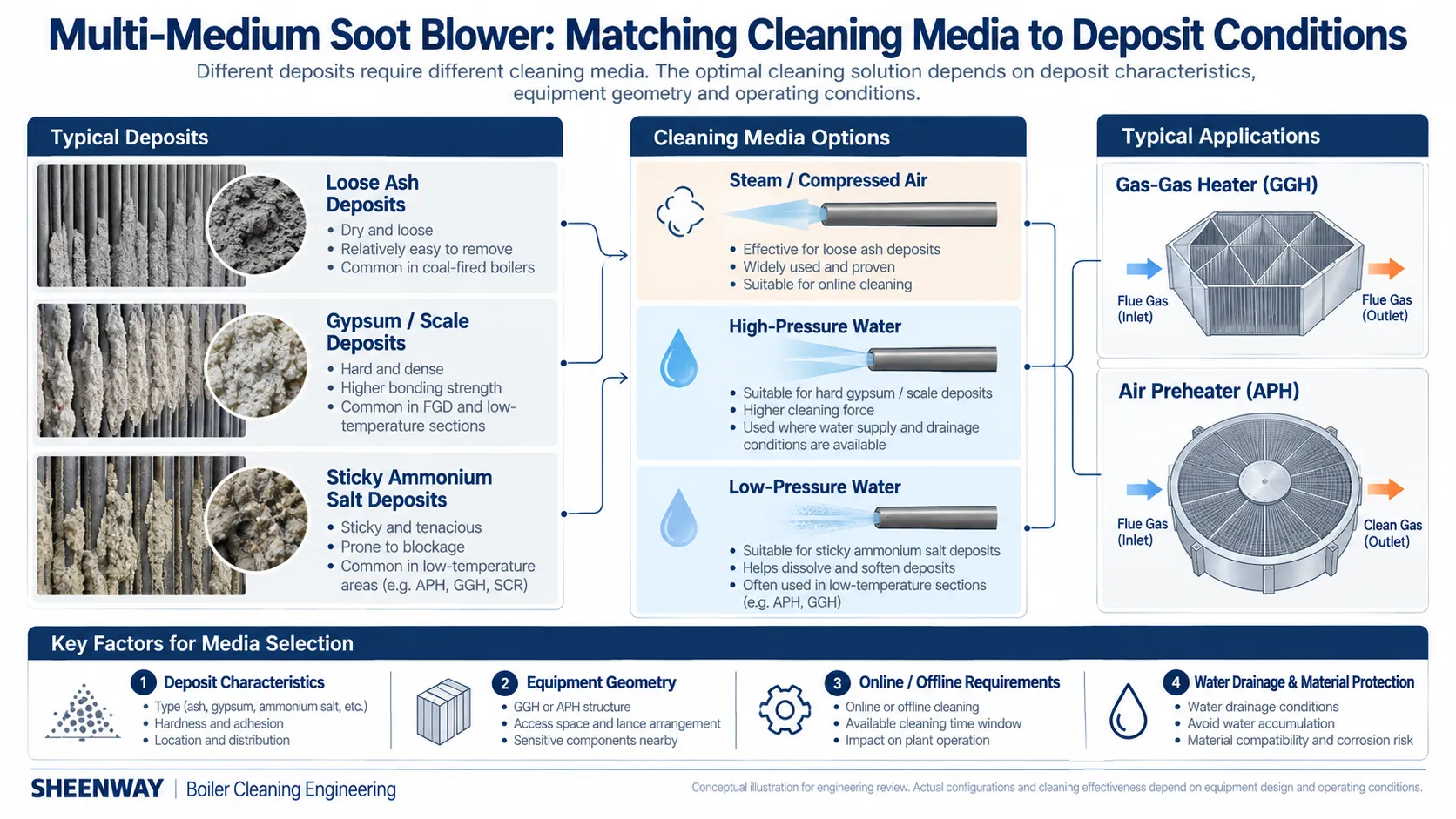
Steam soot blowing is an established method for removing ash deposits from boiler heating surfaces.
In many applications, a high-velocity steam jet provides sufficient mechanical energy to dislodge accumulated particulate matter, helping maintain heat-transfer performance and gas-flow passages.
However, not every deposit behaves like loose fly ash.
Some heat exchangers operate in environments where deposits contain moisture, gypsum, ammonium salts or other substances that can form more strongly bonded layers.
These deposits may become difficult to remove through conventional steam or compressed-air blowing alone.
This creates a different engineering question:
When should a cleaning system provide more than one cleaning medium?
A multi-medium retractable soot blower addresses this requirement by allowing different cleaning methods to be incorporated into an application-specific equipment configuration.
The objective is not to use every available cleaning medium during every cycle.
It is to match the cleaning method to the deposit characteristics, heat-exchanger construction and permitted operating conditions.
This article explains the engineering principles behind multi-medium soot blowing and the application logic of the SHEENWAY SW-SMRS.https://sheenwaypower.com/products/sw-smrs/
1. Why Different Deposits Require Different Cleaning Methods
The effectiveness of a soot blower depends on how the cleaning medium interacts with the deposit.
Loose particulate deposits may be removed through aerodynamic forces and mechanical impact.
Other deposits may have greater adhesion to the underlying surface.
Moisture and chemical reactions can also change deposit properties.
For example, an air preheater operating downstream of a selective catalytic reduction (SCR) system may experience deposition associated with ammonia slip and sulfur-containing flue-gas compounds.
Research published in Fuel has identified ammonium bisulfate (ABS) as an important contributor to air-preheater fouling and plugging.
ABS can form sticky deposits and promote fly-ash adhesion to heat-transfer surfaces.
As deposits accumulate, gas passages may become restricted and pressure drop may increase.
This does not mean that every air-preheater deposit contains ABS.
The actual deposit chemistry depends on fuel, flue-gas composition, temperature and operating conditions.
The engineering principle is that cleaning-medium selection should begin with deposit identification.
A cleaning system designed for loose fly ash may not be equally effective against strongly bonded or chemically influenced deposits.
2. Why Steam Blowing May Become Insufficient
Steam soot blowing removes deposits primarily through the mechanical action of a directed jet.
The cleaning effect depends on several interacting parameters:
- steam pressure and available flow;
- nozzle geometry;
- distance to the deposit;
- jet direction and coverage;
- deposit adhesion;
- and the mechanical characteristics of the target surface.
When the deposit remains relatively loose, properly configured steam blowing can be effective.
However, increasing steam pressure or blowing frequency does not necessarily solve every cleaning problem.
If the cleaning jet cannot reach the affected region, additional pressure may not correct the coverage limitation.
If the deposit is strongly bonded, the mechanical energy available from the steam jet may be insufficient.
If sticky deposits are continuously forming because of upstream process conditions, soot blowing may remove some material without addressing the underlying formation mechanism.
Historical technical assessments by the U.S. Environmental Protection Agency have documented air-preheater applications where ammonium sulfate and ammonium bisulfate deposition caused increasing pressure drop despite soot blowing.
Water washing was required in some installations to restore acceptable flow conditions.
This demonstrates an important limitation:
Soot blowing can control certain deposits, but it does not necessarily eliminate every form of fouling or plugging.
3. What Is a Multi-Medium Retractable Soot Blower?
A multi-medium retractable soot blower is a cleaning system designed around the possible use of different cleaning media.
Depending on the application, these may include:
Superheated Steam
Used for routine mechanical removal of suitable deposits.
Compressed Air
An alternative gaseous cleaning medium when the available pressure, flow and cleaning requirements are compatible.
High-Pressure Water
Considered for particular washing applications where the deposit and equipment design justify water cleaning.
Low-Pressure Water
Used in certain washing arrangements that require comparatively large water volumes rather than concentrated high-pressure impact.
The SHEENWAY SW-SMRS Multi-Medium Retractable Soot Blower is intended for applications involving deposits on gas-gas heaters and certain air-preheater installations.
Its documented configurations may use fully retractable or semi-retractable arrangements.
The product documentation also identifies multiple cleaning media and project-specific mechanical configurations.
However, the presence of several possible cleaning media in the product range does not mean that every SW-SMRS installation includes all four media.
The actual configuration must be established through the project specification.
4. Application One: Gas-Gas Heater Cleaning in FGD Systems
A gas-gas heater, commonly abbreviated as GGH, may be installed as part of a flue-gas desulfurization system.
In certain wet FGD arrangements, the GGH transfers heat between different flue-gas streams, helping manage gas temperatures within the desulfurization process.
Wet limestone-gypsum FGD systems involve chemical reactions that produce gypsum as a by-product.
Depending on the arrangement, entrained droplets, particulate matter and other process conditions may contribute to deposits on equipment associated with the gas path.
Mitsubishi Heavy Industries identifies gas-gas heaters as equipment used in wet flue-gas desulfurization installations.
For GGH cleaning applications, SHEENWAY's SW-SMRS documentation identifies ash and gypsum-related deposits as intended cleaning targets.
The engineering difficulty is that these deposits may not behave like dry fly ash.
Their adhesion and response to cleaning can depend on moisture, deposit composition and operating history.
Routine steam blowing may help control removable deposits.
Where cleaning becomes insufficient, a properly engineered water-washing arrangement may be considered.
But water washing introduces additional requirements involving drainage, wastewater collection, material compatibility and operating procedures.
5. Application Two: Air Preheater Deposits Downstream of SCR
The second important application is air-preheater fouling in systems where SCR equipment is installed upstream.
SCR reduces nitrogen oxides through reactions involving a reducing agent, commonly ammonia.
Under certain operating conditions, residual ammonia can interact with sulfur-containing flue-gas compounds.
One important resulting substance is ammonium bisulfate (NH₄HSO₄).
ABS may form sticky deposits on air-preheater heat-transfer elements and promote the accumulation of fly ash.
This problem has been examined in both academic research and regulatory technical reports.
A review of ABS deposition and control technologies notes that conventional steam soot blowing may not adequately remove established ABS-related deposits.
Water washing can be effective in some circumstances, although repeated washing also creates wastewater and corrosion-management concerns.
This is why cleaning a downstream air preheater cannot always be approached in the same way as cleaning a conventional boiler tube bank.
The cleaning strategy should consider both the physical deposit and the chemical environment responsible for its formation.
For a new cleaning system or retrofit, the first step is to identify the actual deposit condition rather than assuming that every pressure-drop increase is caused by loose ash.
6. Steam, Compressed Air and Water: Different Roles
The available cleaning media should not be treated as interchangeable options.
Each has different operating characteristics and infrastructure requirements.
| Cleaning Medium | Typical Engineering Role | Main Considerations |
|---|---|---|
| Superheated steam | Routine online removal of suitable deposits | Pressure, flow, steam condition, nozzle configuration and drainage |
| Compressed air | Gaseous cleaning alternative in suitable applications | Available pressure and flow, air quality and jet effectiveness |
| High-pressure water | Supplementary washing for deposits requiring a different removal mechanism | Element protection, water pressure, coverage, operating permission and drainage |
| Low-pressure water | Selected washing applications requiring significant water volume | Water supply, equipment isolation, drainage and wastewater handling |
This comparison does not establish a universal performance ranking.
A correctly designed compressed-air system may be suitable for a particular application, while a steam system may be preferable in another.
Likewise, high-pressure water is not automatically more appropriate than steam.
Its use must be justified by the deposit, equipment materials and approved operating conditions.
7. Online and Offline Cleaning Are Different Engineering Conditions
One of the most important questions in multi-medium cleaning is whether a particular washing operation can be carried out while the heat exchanger remains in service.
Online cleaning means cleaning is performed while the relevant equipment continues operating under an approved cleaning procedure.
Offline cleaning means the relevant equipment or section is removed from service and placed into the required safe condition before cleaning.
SHEENWAY's SW-SMRS product documentation describes several application arrangements.
For GGH equipment, high-pressure water cleaning may be configured for online washing.
For air preheaters, high-pressure water washing is generally described as an offline operation in the current product documentation.
Low-pressure water washing is described for offline GGH cleaning.
These arrangements should not be interpreted as universal operating rules.
The wider industry also includes specially engineered online water-washing systems for certain air preheaters.
Veolia's industrial water-treatment guidance, for example, discusses air-preheater washing arrangements in which individual units can be isolated and washed while other equipment remains operating.
The correct distinction is therefore not simply whether the cleaning medium is water.
It is whether the specific equipment, materials, isolation, drainage and operating procedure permit that washing method under the intended conditions.
8. Why High-Pressure Water Is Not Automatically the Best Solution
High-pressure water can provide a cleaning mechanism different from gaseous soot blowing.
Depending on the deposit properties, it may help remove material that is difficult to dislodge through steam alone.
However, increasing water pressure also increases the need to evaluate potential equipment damage.
Thin heat-transfer elements may be vulnerable to excessive direct jet impact.
Some materials and coatings may require special precautions.
Thermal conditions may restrict when water can be introduced safely.
Large quantities of water also require suitable drainage paths.
The cleaning system should therefore consider:
water pressure + nozzle design + stand-off distance + target material + operating temperature + drainage arrangements.
The maximum available pump pressure should not be treated as the normal operating target.
The correct pressure and flow must be established for the approved cleaning design.
9. Water Washing Introduces Wastewater and Corrosion Considerations
Water washing does not end when the cleaning jet stops.
The wash water may contain dissolved salts, ash, corrosion products and other materials removed from the heat exchanger.
For air preheaters affected by ammonium salt deposition, the wastewater may contain ammonium and sulfate species.
EPA technical assessments identify wastewater collection and treatment as important considerations in these cleaning applications.
Water-treatment guidance also notes that air-preheater washing can produce acidic wastewater and that corrosion control and suitable drainage are important.
Therefore, the cleaning plan should address:
- water collection and drainage;
- applicable wastewater-treatment requirements;
- material and coating compatibility;
- inspection after washing;
- and the equipment's required return-to-service condition.
These requirements should be established by the equipment owner and engineering team.
Water should not be introduced into an operating heat exchanger merely because a cleaning device can supply it.
10. Full-Retractable or Semi-Retractable Configuration?
The SW-SMRS product documentation allows for fully retractable and semi-retractable arrangements.
This introduces another selection decision.
A fully retractable arrangement allows the cleaning lance to withdraw from the active cleaning region after operation.
A semi-retractable arrangement leaves part of the lance within the gas path.
The appropriate choice depends on factors such as:
Flue-gas temperature
The exposed lance section must be suitable for the operating environment.
Required cleaning coverage
The nozzle arrangement and mechanical travel must reach the relevant deposit area.
Available installation space
Existing platforms, structural members and adjacent equipment may restrict external travel.
Support arrangement
A permanently exposed lance section may require additional internal support.
Cleaning-medium connections
Water-washing applications may require compatible hoses, piping, valves and other components.
Maintenance access
The cleaning assembly must remain accessible for inspection and servicing.
The correct retractable configuration should be determined from the actual project rather than chosen solely to reduce equipment length.
11. SW-SMRS Reference Configuration and Engineering Parameters
SHEENWAY's current SW-SMRS documentation identifies the following product characteristics.
| Parameter | SW-SMRS Reference |
|---|---|
| Product | Multi-Medium Retractable Soot Blower |
| Typical applications | GGH and selected air-preheater cleaning applications |
| Retractable arrangement | Fully retractable or semi-retractable, depending on design |
| Available cleaning-media options | Superheated steam, compressed air, low-pressure water, high-pressure water |
| Total travel | Project-specific |
| Blowing travel | Project-specific |
| Heat-exchanger rotational speed, where applicable | Project-specific |
| Blowing-medium pressure | Project-specific |
| Nozzle quantity and diameter | Project-specific |
| Step count and travel increment, where applicable | Project-specific |
| Dwell time and operating duration | Project-specific |
| Medium consumption | Project-specific |
The product documentation also identifies components that may be relevant to multi-medium arrangements, including a travelling carriage, feed tube, blowing lance assembly, high-pressure hose, control equipment and high-pressure pump system.
These are documented product-family components and possible configuration requirements.
They should not be interpreted as confirmation that every SW-SMRS installation has identical mechanical construction or all possible cleaning functions.
The final equipment configuration must be confirmed for the individual project.
12. What Should Be Checked Before Selecting a Multi-Medium Soot Blower?
A useful engineering inquiry should begin with the heat exchanger and deposit problem.
| Required Information | Why It Matters |
|---|---|
| Equipment type and model | Identifies the GGH or air-preheater configuration |
| Heat-transfer element arrangement | Defines target geometry and mechanical sensitivity |
| Deposit composition | Determines whether steam, air or washing should be evaluated |
| Deposit location and severity | Identifies the cleaning area and accessibility |
| Operating temperature | Affects material selection and permitted cleaning conditions |
| Existing cleaning system | Establishes the current equipment and its limitations |
| Steam or compressed-air conditions | Confirms available gaseous cleaning media |
| Water supply and pressure | Supports evaluation of possible washing arrangements |
| Online/offline restrictions | Defines permissible cleaning operations |
| Drainage and wastewater handling | Determines whether water washing can be implemented |
| Installation interfaces | Supports retrofit compatibility |
| Controls and interlocks | Defines operating and protection requirements |
For retrofit projects, existing drawings and maintenance observations can be particularly useful.
The engineering objective should be to identify why the current cleaning method is insufficient before specifying a different medium.
13. When a Multi-Medium Soot Blower May Not Be Necessary
Multi-medium cleaning is not automatically the best choice for every boiler.
If deposits remain loose and are effectively controlled by the existing steam soot blowers, adding a water-washing system may introduce unnecessary complexity.
Additional media can require:
extra piping,
pumps,
hoses,
valves,
controls,
and wastewater-management facilities.
These systems also increase the number of components requiring maintenance.
A multi-medium solution becomes more relevant when the deposit characteristics and operating requirements justify those additional capabilities.
For some applications, improving the existing steam-blowing coverage or addressing the upstream causes of deposit formation may be a more appropriate first step.
14. How Should Cleaning Effectiveness Be Evaluated?
The success of a cleaning strategy should be assessed using the actual operating response.
For a GGH or air preheater, useful observations may include:
- pressure-drop trends under comparable operating conditions;
- relevant gas-temperature trends;
- changes in cleaning frequency or effectiveness;
- inspections of heat-transfer elements;
- evidence of persistent plugging;
- and signs of corrosion or mechanical damage.
These indicators require careful interpretation.
For example, pressure drop depends on gas flow as well as deposit accumulation.
Changes in heat-transfer performance may also reflect operating conditions unrelated to the cleaning equipment.
A multi-medium system should therefore be evaluated by whether it controls the intended deposit problem without creating unacceptable equipment or operating risks.
Conclusion
The need for a multi-medium retractable soot blower arises when the deposit and equipment conditions cannot be adequately addressed by a single conventional cleaning method.
Loose ash, gypsum-related deposits and sticky ammonium salt deposits do not necessarily respond to cleaning in the same way.
Steam and compressed air can provide effective gaseous cleaning in suitable applications.
Water washing may offer a supplementary method for deposits that are difficult to remove mechanically, but its use introduces important requirements involving equipment protection, temperature, drainage and wastewater handling.
The SHEENWAY SW-SMRS is designed for project-specific cleaning applications involving GGH equipment and selected air preheaters.
Its configurations can incorporate different cleaning-media options according to the actual engineering requirements.
The selection principle is straightforward:
Do not start by choosing the strongest cleaning medium. Start by identifying the deposit, the heat-exchanger geometry and the operating conditions.
For new installations and retrofit projects, SHEENWAY can review equipment information, deposit characteristics and available cleaning-media conditions to assess an appropriate SW-SMRS configuration.
More from Sheenway
Continue Reading
Retractable Boiler Temperature Probe: Why It Matters During Boiler Startup
During boiler startup, furnace exit gas temperatures can rise before sufficient steam cooling is established in certain heating surfaces. A retractable boiler temperature probe positions a thermocouple in the gas path to provide temperature information for operating decisions. This guide explains the working principle, startup applications, measurement limitations and selection requirements of the SHEENWAY SW-MTPS.
Read articleRake-Type Soot Blower Design for SCR: Nozzle Layout, Travel and Support
Rake-type soot blowers use non-rotating, axially moving cleaning assemblies to direct steam or compressed air toward SCR catalysts and other structured surfaces. This guide explains nozzle layout, travel, support and guide arrangements, cleaning-medium conditions and the engineering checks required before selecting or replacing a rake-type soot blower.
Read articleHow to Select a Sonic Soot Blower: Frequency, Coverage and Installation Requirements
Selecting a sonic soot blower requires more than comparing frequency and acoustic output. Deposit characteristics, equipment geometry, installation distance, compressed-air supply and structural resonance all influence the effectiveness of acoustic cleaning. This guide explains the main engineering selection factors and introduces the SHEENWAY Sonic Soot Blower product range.
Read article