
How to Specify a Replacement Soot Blower Lance Tube: 10 Details Buyers Should Confirm
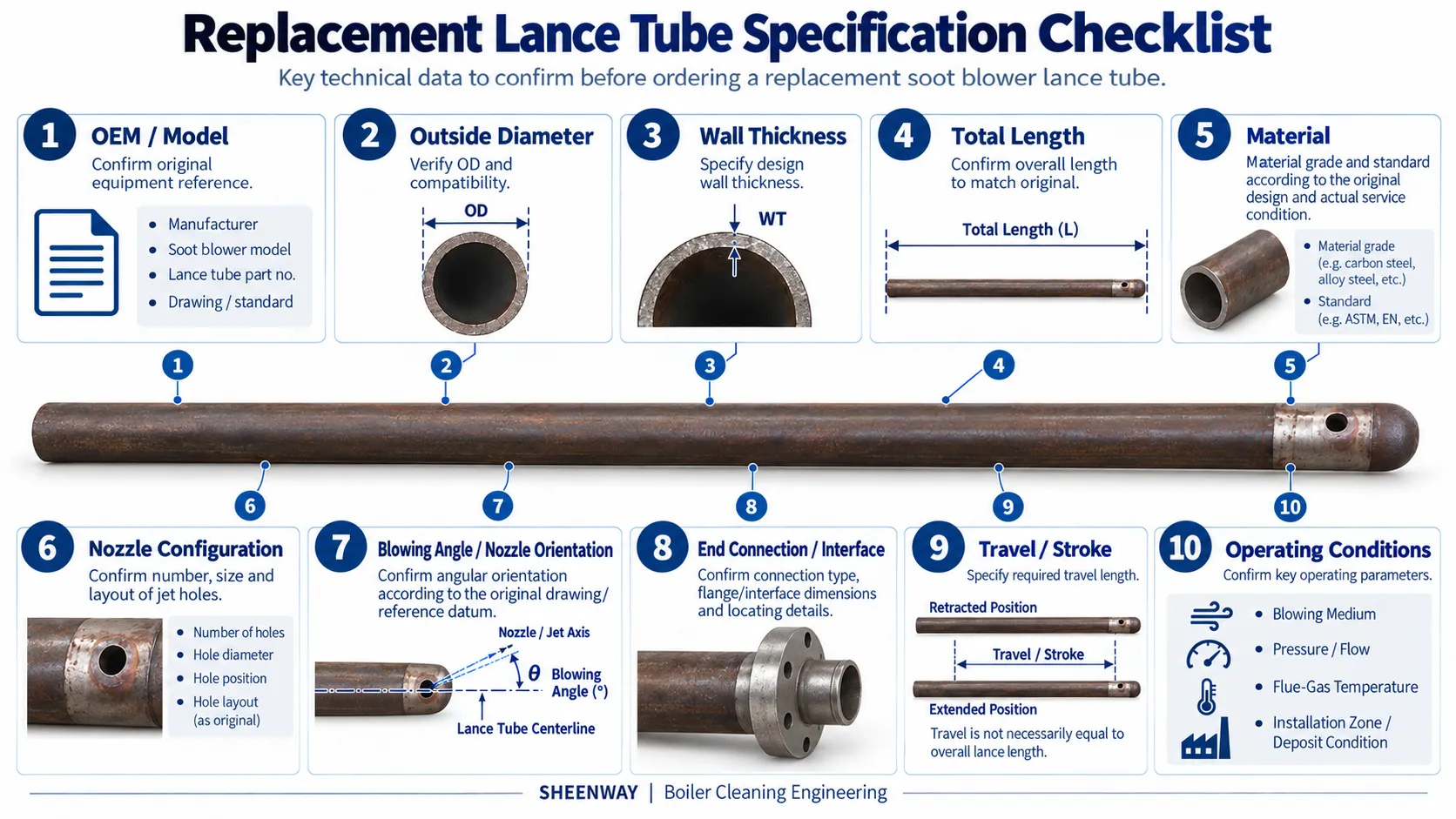
Ordering a replacement soot blower lance tube requires more than outside diameter, wall thickness and length. Nozzle configuration, blowing angle, material, interfaces, soot blower travel and operating conditions can all affect compatibility. This guide explains the technical information buyers should confirm before requesting a replacement lance tube.
How to Specify a Replacement Soot Blower Lance Tube: 10 Details Buyers Should Confirm
A soot blower lance tube can look like a relatively simple spare part.
It is long, cylindrical and often described in a purchasing request using only three dimensions:
outside diameter × wall thickness × length.
Those dimensions are important.
But for a replacement soot blower lance tube, they are rarely the complete specification.
The lance is part of a moving cleaning system. Its geometry must work with the carriage, feed tube, packing and boiler interface. Its nozzle arrangement determines where the cleaning medium is delivered. Its material operates within a particular temperature and flue-gas environment.
A replacement tube can therefore have the correct outside diameter and still be technically incompatible with the existing soot blower.
For replacement and retrofit projects, SHEENWAY uses the original equipment model, structural configuration and actual operating conditions as part of the compatibility review rather than treating a lance tube as a generic length of pipe.
So what should a buyer provide before requesting a quotation?
1. Original Soot Blower Manufacturer, Model and Part Number
Start with the existing equipment identity.
Useful information includes:
- original soot blower manufacturer;
- machine model;
- lance tube part number, if available;
- boiler or plant equipment tag;
- and any existing assembly drawing.
This information does not replace dimensional verification.
But it provides an essential reference point.
Two soot blowers that appear similar externally may use different lance dimensions, nozzle patterns, end connections or travel arrangements.
For cross-brand replacement, the original model should therefore be considered the beginning of the technical review—not the entire specification.
SHEENWAY's current spare-parts program follows this approach by combining original equipment information with dimensional verification and structural comparison when evaluating replacement components.
- Confirm Whether the Part Is a Lance Tube or a Feed Tube
One of the easiest mistakes in an RFQ is to describe both components simply as:
“soot blower tube.”
That is not precise enough.
In retractable soot blower assemblies, the lance tube and feed tube are separate components with different functions and different interface requirements.
The exact architecture varies by soot blower design.
EPRI's Sootblowing Application and Maintenance Guide, for example, documents a Clyde Bergemann retractable rake-blower arrangement in which the feed tube remains fixed while the lance tube moves during insertion and retraction. The guide also notes that the feed-tube finish is important to packing-seal performance in that design.
This illustrates an important purchasing rule:
do not identify the component only by appearance.
When possible, provide the assembly drawing or clearly indicate whether the quotation is for:
Lance Tube
or
Feed Tube.
3. Outside Diameter, Wall Thickness and Total Length
These are the fundamental tube dimensions.
At minimum, specify:
OD — Outside Diameter
WT — Wall Thickness
Overall Length
However, there is an important detail:
overall tube length and soot blower travel are not necessarily the same dimension.
A soot blower may have a defined mechanical travel while the actual lance assembly extends beyond that distance because of its connection, nozzle section or internal mechanical arrangement.
For that reason, writing:
“Lance tube for 6 m travel”
is useful information, but it should not automatically replace an actual tube-length dimension.
Whenever possible, provide both.
For an existing used component, it is also useful to distinguish:
nominal design dimensions
from
as-found measurements.
A tube that has suffered erosion, corrosion or deformation may no longer represent its original specification.
4. Material Grade and Material Standard
A replacement lance should not be manufactured from a material selected only because it has the same approximate dimensions.
Material choice can be influenced by:
- local flue-gas temperature;
- duration of furnace exposure;
- corrosion environment;
- mechanical loading;
- weld design;
- and the original equipment specification.
Different soot blower projects can therefore use different materials for seemingly similar tubular components.
Material substitutions should not be made simply on the assumption that a more expensive alloy is automatically a better replacement.
The relevant question is whether the material has the required mechanical, thermal, corrosion and fabrication characteristics for the actual service condition.
If the original material certificate, drawing or specification is available, send it with the inquiry.
If it is not available, tell the supplier that the material is unknown rather than guessing.
5. Nozzle Quantity and Nozzle Geometry
The lance tube does more than transport steam or compressed air.
It also determines where that cleaning medium leaves the system.
For this reason, the replacement specification should identify, where applicable:
- number of nozzle openings;
- nozzle or opening diameter;
- nozzle type;
- spacing between nozzle positions;
- and axial location of the nozzle group.
SHEENWAY's current long-retractable soot blower documentation makes nozzle quantity and diameter project-dependent, together with blowing-medium pressure and flow.
This is why matching only the tube OD and length is insufficient.
A mechanically compatible tube with the wrong nozzle arrangement can produce a different cleaning field.
6. Blowing Angle and Nozzle Orientation
Two lance tubes can have:
the same length,
the same outside diameter,
the same wall thickness,
and even the same number of nozzle openings,
while still not being functionally equivalent.
The reason can be nozzle orientation.
The angular position of the jet affects where the cleaning energy reaches the heating surface.
National Board guidance emphasizes that sootblower lance orientation must be correctly aligned so that high-velocity steam jets do not incorrectly impinge directly on boiler tubes. It also notes that thermal expansion must be considered when establishing alignment.
For replacement projects, nozzle angle should therefore be treated as a controlled specification.
Do not assume that two visually similar nozzle configurations have the same blowing direction.
Where possible, provide:
blowing angle
and a drawing showing the angular reference.
7. End Connections, Flanges and Mechanical Interfaces
A replacement lance must physically integrate with the existing soot blower.
Depending on the design, the relevant interface information may include:
- flange geometry;
- hub connection;
- thread or welded connection;
- bolt-circle dimensions;
- locating dimensions;
- connection to the carriage;
- and any transition between materials or sections.
These dimensions are particularly important in cross-brand replacement projects.
A tube that has the correct length but cannot correctly connect to the existing carriage or sealing system is not a compatible replacement.
This is why SHEENWAY's replacement process includes verification of dimensions, interfaces and mounting positions rather than only raw-material dimensions.
8. Soot Blower Stroke and Movement
The supplier should also know how the lance operates.
Useful data include:
total travel / stroke
forward and retracting movement
rotational movement, where applicable
and, for more detailed engineering review:
travel and rotational speed.
For the SHEENWAY SW-SLRG Series, travel speed, rotational speed, stroke, nozzle parameters and blowing-medium conditions are interrelated project parameters rather than independent universal values.
This is important because the cleaning path is produced by the combination of:
nozzle geometry + lance position + travel + rotation.
A replacement component should preserve the intended relationship between these elements.
9. Blowing Medium and Actual Operating Conditions
The same mechanical tube geometry can be used under very different operating environments.
A useful RFQ should therefore state the actual operating conditions where known.
These can include:
Blowing medium
Steam or compressed air.
Available pressure and flow
Not simply the nominal plant header pressure if a different condition exists at the soot blower.
Boiler location
For example, superheater, reheater, economizer or another cleaning zone.
Flue-gas temperature
Especially the expected maximum temperature at the installation position.
Fuel and deposit condition
Where this information affects material or cleaning-system evaluation.
This information is relevant because soot blower parameters must be matched to the actual boiler environment.
The current SHEENWAY SW-SLRG documentation explicitly states that stroke, travel speed, rotational speed, nozzle configuration, medium pressure and flow are determined with reference to boiler flue-gas temperature, fuel, ash and cleaning-medium parameters.
10. Drawings, Nameplate Photos and Reference Measurements
The final item is often the most useful.
If available, send:
original part drawing
soot blower assembly drawing
nameplate photograph
photos of the existing lance and its connection
close-up photos of the nozzle area
and
measured dimensions with clear reference points.
A photo with a tape measure is useful.
A dimensioned drawing is better.
An original approved drawing combined with site verification is better still.
For replacement parts, the goal is not to collect the largest possible number of dimensions.
The goal is to establish an unambiguous technical definition of the component.
Replacement Lance Tube RFQ Checklist
| Information | Why It Matters |
|---|---|
| Manufacturer / model / part number | Identifies the original equipment family |
| Lance tube or feed tube | Prevents component misidentification |
| OD / wall thickness / overall length | Defines basic tube geometry |
| Material specification | Relates the part to thermal, mechanical and corrosion conditions |
| Nozzle quantity and size | Affects cleaning-medium distribution |
| Nozzle location and blowing angle | Determines cleaning direction |
| End connection / flange | Determines mechanical compatibility |
| Stroke and movement | Relates the tube to the soot blower mechanism |
| Medium and operating conditions | Provides the actual service environment |
| Drawings / photos / measurements | Allows technical cross-checking |
The checklist is not a substitute for project engineering.
Some soot blower designs may require additional information.
But these ten items provide a substantially better starting point than OD, thickness and length alone.
Why Measuring an Old Tube Can Be Misleading
Field measurement is often necessary when original drawings are unavailable.
But the existing component may already be damaged.
Corrosion can reduce wall thickness.
Erosion can enlarge an opening.
Mechanical deformation can change straightness.
Previous repair work may also have modified the component.
For this reason, it is useful to record field measurements as:
“as found”
rather than automatically treating every measured value as the original design dimension.
Where drawings, earlier purchase records or undamaged matching components exist, they should be compared with the field measurements.
This is particularly important for nozzle geometry and functional interfaces.
Why Nozzle Data Deserve Special Attention
From a purchasing perspective, tube dimensions are easy to measure.
Nozzle details are easier to overlook.
But the nozzle is where pressure and flow are converted into the cleaning jet.
Changing its geometry can change the cleaning result.
This is also why boiler-maintenance guidance places importance on correct sootblower orientation and on preventing incorrect jet impingement on boiler tubes.
If an old lance is being reverse-engineered, photograph and dimension the nozzle section carefully before disposal.
Do not record only the hole diameter.
The orientation and location of the opening may be equally important.
Feed Tube Surface and Sealing Interfaces May Also Matter
A related purchasing issue occurs when the replacement request involves a feed tube rather than the moving lance.
In some retractable sootblower configurations, the feed tube passes through packing or sealing arrangements and therefore performs a functional sealing role.
EPRI's documentation of one Clyde Bergemann configuration specifically notes a ground-finished feed tube intended to support long packing life.
This should not be interpreted as a universal surface-finish requirement for every soot blower.
It does demonstrate why replacing a feed tube purely by OD and length can also be inadequate.
The mating seal and original design must be considered.
Cross-Brand Replacement Requires Compatibility Review
A replacement component does not necessarily have to come from the original equipment manufacturer.
But cross-brand replacement requires technical verification.
SHEENWAY currently provides customized replacement parts for soot blowers of different brands and configurations, including replacement support for Diamond and Clyde Bergemann equipment. The company's published process includes measurement, dimensional verification, structural analysis and technical comparison.
This should not be interpreted as meaning that one generic Sheenway lance fits every Diamond or Clyde soot blower.
The correct principle is the opposite:
each replacement should be matched to the actual original configuration.
Compatibility should be demonstrated by technical data, not assumed from brand names.
What Should Not Be Used as the Only Purchasing Basis?
Several pieces of information are useful but are not sufficient on their own:
“It is for a 5.7 m soot blower.”
“The tube is approximately 76 mm.”
“The existing machine is a long retractable soot blower.”
“It looks the same as this photo.”
“The original manufacturer is Brand X.”
Each of these narrows the search.
None defines the complete replacement component.
The more critical the application, the more important it becomes to verify the full geometry and operating context before production.
A Better Way to Send an RFQ
A useful initial request can be surprisingly simple.
Instead of sending:
Need lance tube, 76 mm, 6 meters. Please quote.
send a technical package containing:
Equipment: Long Retractable Soot Blower
Existing Manufacturer / Model: ______
Part Required: Lance Tube
OD × WT × Overall Length: ______
Material: ______
Nozzle Quantity / Size: ______
Blowing Angle: ______
Stroke: ______
Blowing Medium: ______
Installation Area / Temperature: ______
Drawing / Photos: Attached
If some items are unknown, write:
Unknown — please review from drawing / sample.
That is more useful than filling the blank with an uncertain value.
Conclusion
A replacement soot blower lance tube should not be treated as generic pipe.
Its outside diameter, wall thickness and length define only part of the component.
Material, nozzle geometry, blowing angle, interfaces, travel and operating conditions can all affect whether the replacement is technically compatible with the existing soot blower.
For this reason, SHEENWAY evaluates replacement components using original equipment information, dimensional verification, structural comparison and actual operating conditions.
The principle is simple:
A part that fits physically is not necessarily a part that performs equivalently.
Before manufacturing a replacement lance tube, define both:
the geometry of the component
and
the operating function it must reproduce.
More from Sheenway
Continue Reading
Retractable Boiler Temperature Probe: Why It Matters During Boiler Startup
During boiler startup, furnace exit gas temperatures can rise before sufficient steam cooling is established in certain heating surfaces. A retractable boiler temperature probe positions a thermocouple in the gas path to provide temperature information for operating decisions. This guide explains the working principle, startup applications, measurement limitations and selection requirements of the SHEENWAY SW-MTPS.
Read articleRake-Type Soot Blower Design for SCR: Nozzle Layout, Travel and Support
Rake-type soot blowers use non-rotating, axially moving cleaning assemblies to direct steam or compressed air toward SCR catalysts and other structured surfaces. This guide explains nozzle layout, travel, support and guide arrangements, cleaning-medium conditions and the engineering checks required before selecting or replacing a rake-type soot blower.
Read articleMulti-Medium Retractable Soot Blowers: When Steam Alone Is Not Enough
Steam soot blowing is effective for many boiler cleaning applications, but certain gypsum, salt and strongly bonded deposits may require additional cleaning methods. This guide explains how multi-medium retractable soot blowers combine different cleaning options, when water washing may be considered, and how engineers select an appropriate solution for gas-gas heaters and air preheaters.
Read article