
Furnace Soot Blowers: Why Waterwall Cleaning Requires a Different Design
Furnace waterwall cleaning presents different challenges from cleaning superheater and reheater tube banks. This article explains why short-retractable furnace soot blowers use controlled axial movement, fixed-position rotation and directed cleaning jets, and how slagging, blowing arc, medium conditions and boiler geometry affect selection.
Not every heating surface inside an industrial boiler can be cleaned with the same type of soot blower.
A superheater tube bank, an economizer and a furnace waterwall may all develop ash deposits, but their operating environments and cleaning requirements are different.
Furnace waterwalls are exposed directly to the combustion environment. Depending on fuel composition, temperature and combustion conditions, ash can accumulate on these surfaces and may develop into strongly bonded slag deposits.
This creates a specific engineering problem:
How can cleaning energy be directed across a furnace wall without requiring a long lance to travel through the boiler?
One established solution is the furnace soot blower, also called a furnace wall soot blower or short-retractable wall blower.
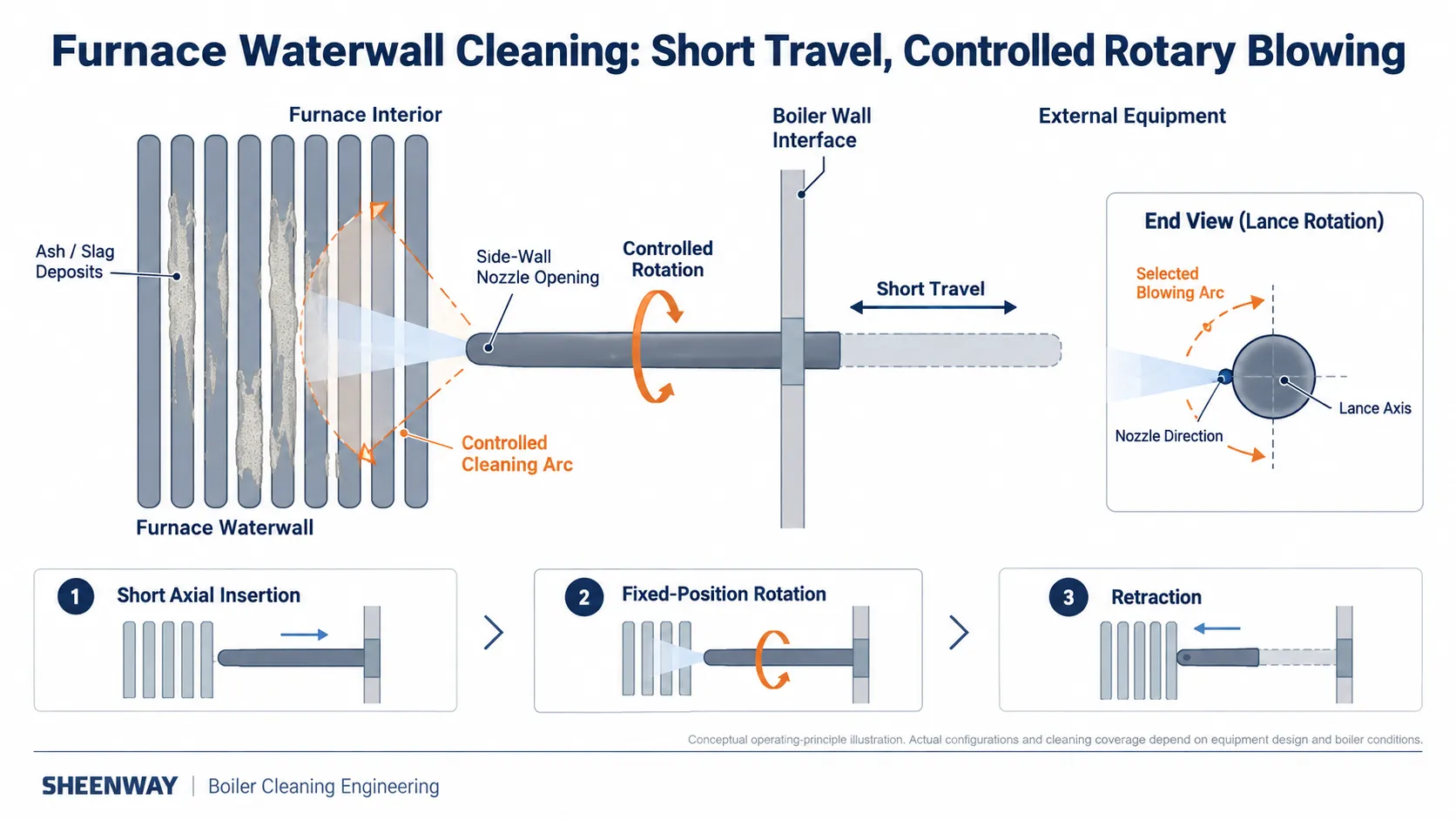
Unlike a long retractable soot blower, which travels deep into convective tube banks, a furnace soot blower typically uses a short insertion movement followed by controlled rotation at a defined cleaning position.
Understanding this difference is essential when selecting a soot blower for boiler waterwall cleaning.
1. Why Furnace Waterwalls Require a Different Cleaning Approach
Waterwalls are made of water- or steam-cooled tubes that form part of the furnace enclosure.
Their primary function is to absorb heat from the combustion process while containing the furnace environment.
However, the same surfaces can also collect ash and slag.
Babcock & Wilcox distinguishes between slagging on surfaces exposed to intense radiant heat and fouling on downstream convection heating surfaces. The behavior of ash depends on factors including fuel chemistry, particle characteristics, gas temperature and combustion conditions.
In the furnace, deposits may remain relatively loose or develop into more strongly bonded material.
Some deposits can be removed by conventional online soot blowing. Others, particularly dense or fused slag, may require a different cleaning method.
This distinction matters because the cleaning system must be selected according to the actual deposit condition—not simply because the target surface is called a waterwall.
A furnace soot blower is primarily intended to deliver cleaning energy to the wall surface while maintaining a suitable relationship between the nozzle, cleaning angle and target area.
2. How Does a Furnace Soot Blower Work?
The fundamental operating principle is relatively simple.
A short-retractable furnace soot blower moves its cleaning lance a short distance from the boiler wall into a defined working position.
Once the lance reaches the required cleaning position, the cleaning medium is discharged through the nozzle while the lance rotates through the selected blowing arc.
The directional jet acts on deposits attached to the surrounding furnace wall surfaces.
After the cleaning cycle, the equipment returns to its standby position.
This operating principle is consistent with the description of furnace wall blowers in EPRI's Sootblowing Application and Maintenance Guide, which identifies short insertion and controlled rotary cleaning as characteristic features of this equipment category.
SHEENWAY's SW-SFBA and SW-SFBB Furnace Soot Blowers follow the same basic operating concept.
Both use a single-nozzle configuration that moves forward to the preset position and then performs rotary soot blowing at a fixed location.
The blowing arc, number of cleaning rotations and blowing pressure can be adjusted according to the requirements of the installation and the nature of the deposits.
The key operating relationship is:
Short Axial Travel → Cleaning Position → Controlled Rotary Blowing → Retraction
3. Why Is the Travel Stroke So Short?
This is one of the most important design differences between a furnace soot blower and a long retractable soot blower.
A long retractable soot blower must carry its nozzles deep into boiler tube banks.
Its axial movement is therefore a major part of the cleaning coverage.
Furnace waterwall cleaning is different.
The target is a wall surface extending around the furnace enclosure rather than a deep series of tube rows that the lance must penetrate.
The furnace soot blower can therefore position its nozzle a short distance beyond the boiler wall and use rotation to direct the cleaning jet across the required surface area.
This reduces the need for long axial movement.
In SHEENWAY's current product documentation, both SW-SFBA and SW-SFBB have a reference stroke of 267 mm (10.5 in).
This dimension represents the product's mechanical travel, not its cleaning radius.
The distinction is important:
Stroke describes how far the lance moves. Cleaning radius describes the distance over which the jet may provide an effective cleaning action under the relevant conditions.
These two values should not be confused when evaluating cleaning coverage.
4. Controlled Blowing Arc: Why Rotation Does Not Mean Cleaning Everywhere
A furnace soot blower rotates, but the entire surrounding area does not necessarily require the same cleaning action.
The required blowing region depends on the furnace wall geometry, soot blower location, nearby openings and the actual distribution of deposits.
For this reason, furnace soot blowing can use a predetermined blowing arc rather than applying the cleaning jet continuously in every direction.
EPRI describes furnace wall blowers as capable of cleaning through a selected arc or a full rotational sweep, depending on the design.
SHEENWAY's SW-SFBA and SW-SFBB documentation likewise identifies adjustable blowing arc as a product feature.
This allows the cleaning operation to be configured around the target region.
The engineering objective is not simply to rotate the lance.
It is to ensure that:
- the jet reaches the intended deposit area;
- the selected arc matches the wall geometry;
- unnecessary direct jet exposure is avoided;
- and adjacent cleaning positions provide the required overall coverage.
The actual blowing arc must be confirmed for each installation.
5. Why Nozzle Direction Matters
A soot blower does not clean a surface merely because steam or compressed air is released nearby.
The cleaning jet must be directed toward the relevant deposits.
Its effectiveness depends on the relationship between nozzle geometry, blowing-medium conditions and the distance to the target.
B&W defines cleaning radius in terms of the distance over which a soot blower can effectively clean when the jet has an unobstructed path to the surface.
For a furnace soot blower, nozzle orientation is therefore part of the cleaning geometry.
The current SHEENWAY SW-SFBA and SW-SFBB product specifications include a single nozzle with a reference opening diameter of 25.4 mm and a nozzle rear-inclination angle of 3°.
These are product reference values, not universal nozzle dimensions for every furnace soot blower.
When evaluating a replacement or retrofit, nozzle orientation should be checked against the approved design.
A replacement nozzle with the correct opening diameter but an incorrect orientation may change the jet's path across the waterwall.
6. Blowing Pressure and Cleaning Intensity Must Match the Deposit
The amount of cleaning energy delivered to a deposit depends on more than the nominal pressure of the steam or compressed-air supply.
Important considerations include nozzle geometry, medium pressure and flow, cleaning distance, jet direction and deposit properties.
SHEENWAY currently lists approximately 1.5 MPa as a reference soot-blowing pressure for its SW-SFBA and SW-SFBB furnace soot blowers.
This should not be interpreted as a universal recommended pressure for every furnace wall or every type of slag.
The required operating conditions must be confirmed for the specific boiler.
Increasing pressure is not automatically the correct response when deposits remain after cleaning.
The underlying problem may involve:
- excessive deposit bonding;
- insufficient jet coverage;
- incorrect nozzle orientation;
- changes in fuel or ash characteristics;
- or limitations of the selected cleaning technology.
A technically appropriate solution begins by identifying which factor is responsible.
7. Why Deposit Characteristics Matter More Than the Number of Cleaning Cycles
Furnace deposits do not always respond to cleaning in the same way.
A porous ash layer can behave differently from a dense, partially fused or resolidified slag deposit.
Babcock & Wilcox emphasizes preventive control of furnace slagging. Deposits are generally easier to manage before they develop into more difficult, strongly bonded forms.
This has an important implication for soot blower operation.
The objective is not to operate the blower as many times as possible. It is to control deposits while they remain removable by the selected cleaning method.
More rotations may increase cleaning exposure, but they cannot guarantee removal of an unsuitable deposit.
The blowing frequency and cleaning sequence should therefore be reviewed against fuel characteristics, boiler load, observed slagging and the actual response to previous cleaning cycles.
A predetermined schedule may provide an initial operating framework, but it should not replace assessment of the boiler's actual condition.
8. When Conventional Steam or Air Blowing Is Not Enough
An important limitation must be acknowledged.
Not every furnace slag deposit can be effectively removed by a conventional steam or compressed-air soot blower.
Both B&W and EPRI distinguish ordinary furnace wall blowing from water-based cleaning technologies intended for particularly difficult slag deposits.
The reason is that strongly fused deposits may not respond adequately to the available mechanical impact from steam or air jets.
This does not mean that water cleaning is automatically the correct alternative.
Water-based cleaning introduces its own engineering and operating requirements and must be evaluated against the boiler design, thermal conditions and applicable operating procedures.
The important selection principle is:
A furnace soot blower should be chosen for deposits that its cleaning mechanism can reasonably control.
If the deposit condition lies outside that capability, a different cleaning strategy may be necessary.
9. Furnace Soot Blower vs Long Retractable Soot Blower
Although both types may use steam or compressed air, their principal cleaning geometries are different.
| Engineering Factor | Furnace Soot Blower | Long Retractable Soot Blower |
|---|---|---|
| Primary cleaning target | Furnace waterwalls | Deep convection tube banks |
| Typical lance movement | Short insertion followed by fixed-position rotation | Long axial travel combined with rotation |
| Main cleaning geometry | Wall area reached from a local cleaning position | Tube-bank area reached along the lance travel path |
| Typical applications | Furnace wall ash and slag deposits | Superheater, reheater, economizer and other convection surfaces |
| Key coverage parameters | Blowing arc, jet direction, cleaning radius and blower location | Stroke, travel speed, rotational speed, nozzle configuration and tube-bank geometry |
| Selection priority | Wall deposit behavior and localized cleaning coverage | Deep tube-bank access and distributed cleaning coverage |
The comparison demonstrates why one design should not automatically replace the other.
A long retractable soot blower may be appropriate for cleaning deeply located tube banks.
But that does not mean a long travel mechanism is required for every furnace wall.
Similarly, a short-retractable furnace soot blower should not be expected to clean an extensive convective tube bank that requires deep lance penetration.
10. SHEENWAY SW-SFBA and SW-SFBB Furnace Soot Blowers
SHEENWAY currently offers the SW-SFBA and SW-SFBB furnace soot blower models.
Both are designed for ash and slag removal from boiler waterwalls and use a short-stroke, single-nozzle rotary cleaning principle.
Their current published reference specifications include:
| Parameter | SW-SFBA / SW-SFBB Reference |
|---|---|
| Application | Boiler furnace waterwalls |
| Stroke | 267 mm (10.5 in) |
| Travel speed | 290 mm/min |
| Lance rotational speed | 2.3 r/min |
| Cleaning medium | Superheated steam or compressed air |
| Reference blowing pressure | Approx. 1.5 MPa |
| Number of nozzles | 1 |
| Nozzle opening diameter | 25.4 mm |
| Nozzle rear-inclination angle | 3° |
| Reference effective blowing radius | 1.5–2 m |
These are reference product specifications, not a guarantee of cleaning performance under every deposit condition.
The current SHEENWAY documents list similar operating parameters for both models, while identifying different valve arrangements and component configurations.
The SW-SFBA component list includes a lift valve, while the SW-SFBB component list identifies a gooseneck valve.
Those differences should be reviewed against the actual equipment drawings and installation requirements. They should not be used alone to infer an unverified performance advantage.
For either model, final configuration and suitability require engineering confirmation.
11. What Should Be Checked Before Selecting a Furnace Soot Blower?
A furnace soot blower should be selected according to the actual boiler layout and operating problem.
The engineering review should consider the following information.
Waterwall geometry
Where are the target wall surfaces, and how are the tubes arranged?
Soot blower installation locations
Where can a cleaning device be mounted, and which areas can be reached from each position?
Deposit characteristics
Is the main issue loose ash, attached slag, or a strongly fused deposit?
Fuel and combustion conditions
Have fuel composition or combustion conditions contributed to changes in slagging behavior?
Required blowing arc and cleaning coverage
Which directions need cleaning, and which areas require restricted jet exposure?
Cleaning medium
Is suitable steam or compressed air available at the required conditions?
Mechanical and control interfaces
Do the wall-box arrangement, power supply, valve sequence and control requirements match the proposed equipment?
Operating and maintenance conditions
Can the blower be inspected, maintained and operated according to the required plant procedures?
These inputs are more useful than selecting a furnace soot blower based only on nominal pressure or nozzle diameter.
12. When Should an Existing Furnace Soot Blower Be Re-Evaluated?
An existing installation may require technical review if its cleaning effectiveness changes.
For example, deposits may remain after normal operation, or the observed pattern of slagging may change when fuel conditions are modified.
Before increasing blowing pressure or frequency, the review should consider whether the selected cleaning arc still covers the intended surface, whether the nozzle and movement mechanisms remain in the specified condition, and whether the deposit has developed beyond the capacity of the original cleaning method.
Wall-box sealing, cleaning-medium condition, mechanical movement and relevant control functions should also be inspected where appropriate.
The objective is to distinguish an equipment problem from a change in the deposit environment.
Simply replacing a furnace soot blower with an externally similar model does not necessarily correct an ineffective cleaning arrangement.
Conclusion
Furnace waterwall cleaning requires a different design approach from deep convective tube-bank cleaning.
Waterwalls are exposed to the furnace combustion environment, where ash may remain loosely bonded or develop into difficult slag deposits.
A short-retractable furnace soot blower addresses this application by moving the lance into a defined cleaning position and then applying controlled rotary jet cleaning across the target wall area.
The critical engineering parameters are not simply equipment length or nominal blowing pressure.
They include:
deposit characteristics, nozzle direction, blowing arc, cleaning radius, wall geometry and available cleaning-medium conditions.
SHEENWAY's SW-SFBA and SW-SFBB furnace soot blowers apply this short-stroke, single-nozzle cleaning principle to boiler waterwall applications.
However, no conventional furnace soot blower should be assumed to remove every form of hard slag.
For reliable selection, the cleaning method must be matched to the actual deposit conditions and boiler geometry.
The right furnace soot blower is the one that provides appropriate cleaning energy to the required waterwall area—not simply the one with the highest blowing pressure or the greatest number of cleaning cycles.
More from Sheenway
Continue Reading
Retractable Boiler Temperature Probe: Why It Matters During Boiler Startup
During boiler startup, furnace exit gas temperatures can rise before sufficient steam cooling is established in certain heating surfaces. A retractable boiler temperature probe positions a thermocouple in the gas path to provide temperature information for operating decisions. This guide explains the working principle, startup applications, measurement limitations and selection requirements of the SHEENWAY SW-MTPS.
Read articleRake-Type Soot Blower Design for SCR: Nozzle Layout, Travel and Support
Rake-type soot blowers use non-rotating, axially moving cleaning assemblies to direct steam or compressed air toward SCR catalysts and other structured surfaces. This guide explains nozzle layout, travel, support and guide arrangements, cleaning-medium conditions and the engineering checks required before selecting or replacing a rake-type soot blower.
Read articleMulti-Medium Retractable Soot Blowers: When Steam Alone Is Not Enough
Steam soot blowing is effective for many boiler cleaning applications, but certain gypsum, salt and strongly bonded deposits may require additional cleaning methods. This guide explains how multi-medium retractable soot blowers combine different cleaning options, when water washing may be considered, and how engineers select an appropriate solution for gas-gas heaters and air preheaters.
Read article