
Long Retractable vs Semi-Retractable Soot Blower: Which Design Fits Your Boiler?
Long retractable and semi-retractable soot blowers use similar mechanical cleaning principles but solve different installation problems. This guide compares lance exposure, flue-gas temperature, cleaning coverage, external space and project-specific parameters to explain how engineers choose between the two designs.
Long Retractable vs Semi-Retractable Soot Blower: Which Design Fits Your Boiler?
Long retractable and semi-retractable soot blowers can look like closely related products.
They both use a moving lance to carry steam or compressed air into a boiler or flue-gas passage. Both can combine axial movement with rotation, and both use strategically arranged nozzles to remove deposits from heating surfaces.
But they are not interchangeable versions of the same machine.
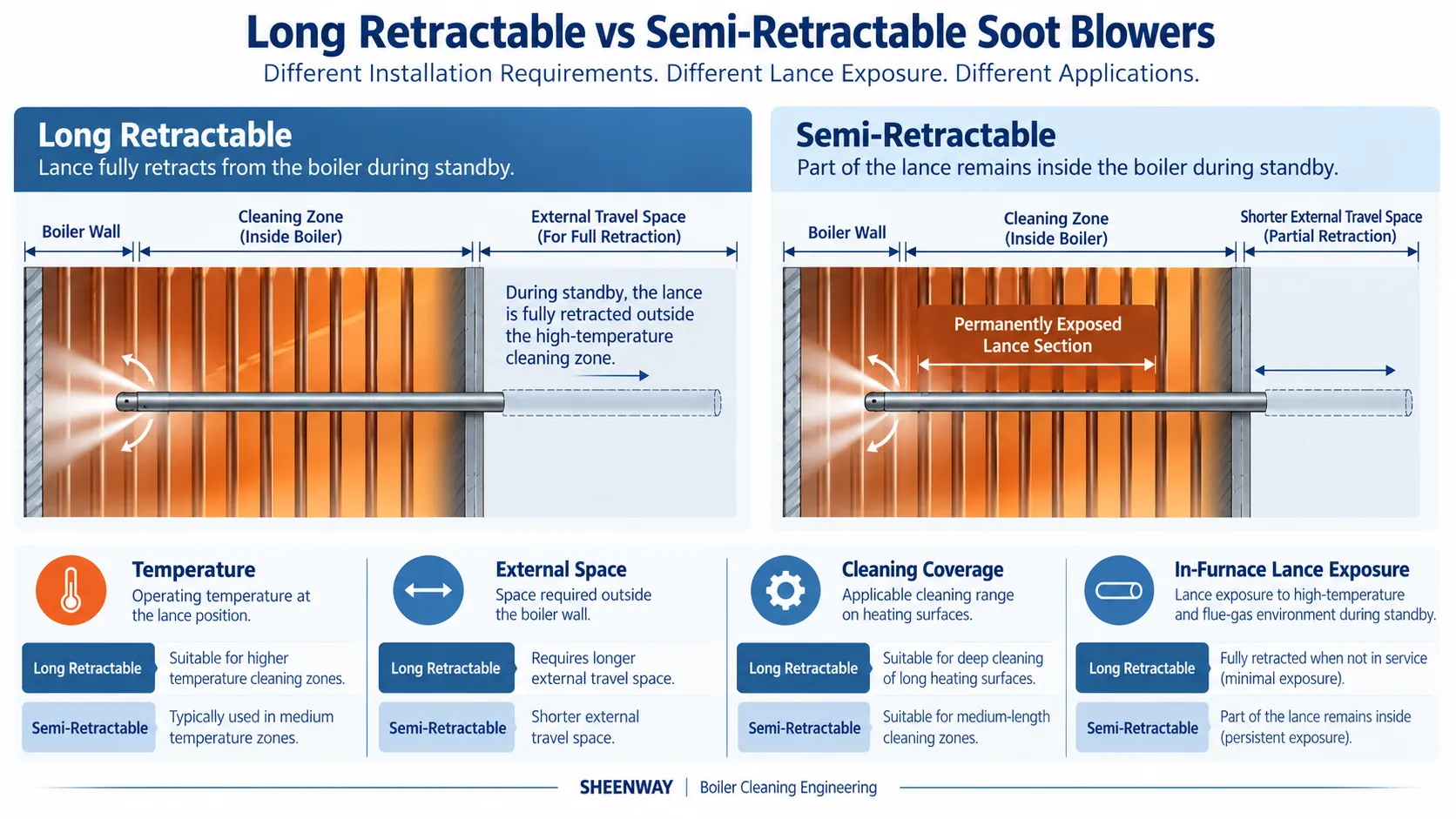
The fundamental difference is what happens to the lance tube when the soot blower is not fully extended.
With a long retractable soot blower, the cleaning lance is withdrawn from the active boiler cleaning zone after operation.
With a semi-retractable soot blower, part of the lance remains inside the flue-gas passage.
That single structural difference affects several engineering decisions:
temperature exposure, available installation space, cleaning coverage, lance support and the required mechanical travel.
The correct selection therefore starts with the boiler geometry and operating environment—not with the product name.
What Is a Long Retractable Soot Blower?
A long retractable soot blower is designed to move its lance deep into boiler tube-bank regions during cleaning and retract it again after the cleaning cycle.
This type of equipment is widely used in convective heating-surface areas such as:
- superheaters,
- reheaters,
- economizers,
- slag-screen areas,
- and certain tubular air-preheater applications.
Babcock & Wilcox describes retractable soot blowers as a primary cleaning solution for convection-pass tube banks, where concentrated cleaning energy must reach surfaces located inside arrays of tubes.
The advantage of retractability becomes particularly important where the environment inside the boiler is thermally demanding.
When the soot blower is not cleaning, the lance does not need to remain continuously exposed to the same high-temperature gas path.
For SHEENWAY's SW-SLRG Series, the current product range includes two stroke classes:
SW-SLRM — maximum stroke 7.60 m
and
SW-SLRX — 7.65 to 13.70 m.
The series is designed for applications including superheaters, reheaters and economizers.
However, stroke alone does not determine the final configuration.
Travel speed, rotational speed, nozzle quantity and diameter, blowing-medium pressure and flow are selected according to actual boiler temperature, fuel and ash characteristics and medium conditions.
What Is a Semi-Retractable Soot Blower?
A semi-retractable—or part-retractable—soot blower applies a different mechanical arrangement.
Part of its blowing lance remains inside the boiler or flue-gas passage even when the machine is in its standby position.
For SHEENWAY's SW-SHRS design, the lance is extended in length and supported by additional in-furnace support structures.
Several groups of nozzles can be arranged along different sections of the lance.
As the soot blower travels, these nozzle groups clean different areas.
This means the effective cleaning coverage can be significantly larger than the mechanical travel of the soot blower itself.
SHEENWAY's current documentation states that the cleaning area can often reach twice the stroke or more, depending on the configuration.
This is one of the main reasons the semi-retractable concept exists.
It allows a relatively compact external travel arrangement to clean a larger internal area.
The Main Difference Is Lance Exposure
The simplest way to understand the two designs is to ask:
Where is the lance when the soot blower is not cleaning?
For a fully retractable design, the lance is withdrawn from the active flue-gas cleaning region.
For a semi-retractable design, part of the lance remains exposed inside the gas path.
This has direct consequences.
A lance that remains inside the boiler must tolerate the local thermal and chemical environment during the entire operating period—not only during a soot-blowing cycle.
The design therefore needs to consider:
- flue-gas temperature,
- material temperature capability,
- corrosion environment,
- lance support,
- thermal expansion,
- and the duration of exposure.
This is why temperature becomes one of the first selection criteria.
Temperature: Why Full Retraction Is Valuable in Hotter Zones
In higher-temperature regions such as parts of the superheater and reheater, continuous lance exposure can impose greater thermal demands on the material.
Industry practice reflects this.
B&W identifies long retractable soot blowers as a major solution for convection-pass cleaning, particularly where cleaning equipment must reach deeply into boiler tube banks.
Other boiler-engineering references likewise describe fully retractable devices as common in high-temperature soot-blowing applications because the lance can be removed from the hot gas stream when cleaning is complete.
By contrast, part-retractable designs deliberately leave a portion of the lance inside the flue-gas path.
For the SHEENWAY SW-SHRS, the current product documentation positions the design primarily in areas where flue-gas temperature is generally below 600°C, including economizers, tubular air preheaters, certain small-boiler convection sections and some waste-heat boilers.
This 600°C figure should not be treated as a universal industry limit.
For example, Clyde Bergemann publishes part-retractable models for applications up to approximately 800°C, while explicitly stating that the upper limit depends on the application.
The engineering conclusion is therefore:
temperature suitability belongs to the specific soot blower design—not to the generic category name.
External Installation Space Can Change the Choice
A long retractable soot blower requires enough external space for the lance travel and machine structure.
For installations with long cleaning depths, this requirement can become significant.
Boiler buildings, maintenance platforms, structural steelwork, adjacent equipment and existing piping may limit the space available behind the boiler wall.
This is where a semi-retractable design can become useful.
Because part of the lance remains inside the gas path, the external mechanical travel does not necessarily need to equal the entire internal cleaning coverage.
SHEENWAY specifically identifies reduced platform-space demand as one of the reasons to use the SW-SHRS in suitable applications.
Clyde Bergemann similarly describes compact installation space as one of the practical advantages of its part-retractable soot blower designs.
This makes external space a genuine engineering selection factor rather than merely an installation inconvenience.
Cleaning Coverage Is Not the Same as Mechanical Stroke
This is one of the most important differences between the two concepts.
For a conventional long retractable soot blower, mechanical stroke is closely related to how far the lance travels into the cleaning zone.
For a semi-retractable design, the relationship can be different.
Because multiple nozzle groups can be distributed along the lance, different sections of the tube can clean different parts of the boiler as the lance moves.
As a result:
cleaning coverage can exceed mechanical travel.
The SW-SHRS documentation states that its cleaning area can often be twice the stroke or more.
This should not be interpreted as a guaranteed universal ratio.
The actual coverage depends on:
- nozzle positions,
- nozzle quantity,
- blowing radius,
- lance geometry,
- tube-bank dimensions,
- and project-specific movement.
It is therefore more accurate to design from the required cleaning area backward to the soot blower geometry than to select a stroke first and assume the coverage afterward.
The Semi-Retractable Design Requires In-Furnace Support
Leaving a longer section of lance inside the boiler creates another requirement:
support.
The lance has to maintain suitable geometry while exposed to its own weight, temperature and repeated motion.
SHEENWAY's SW-SHRS design therefore includes additional lance support plates and an in-furnace barrel-and-support arrangement.
Part-retractable products from other manufacturers follow the same basic concept: Clyde Bergemann states that the blowing tube is supported inside the flue-gas path.
The important point is that reduced external space does not mean that the internal mechanical design becomes simpler.
Some of the structural requirement has effectively moved into the flue-gas path.
For retrofit projects, support geometry must therefore be checked carefully.
Which Design Is Better for High-Temperature Tube Banks?
There is no universal answer based only on equipment category.
But the selection logic is clear.
If the target heating surface is located in a high-temperature region and it is undesirable for the lance to remain continuously exposed to that environment, a fully retractable configuration has an important structural advantage.
This is one reason long retractable soot blowers are widely associated with superheater and reheater cleaning.
SHEENWAY's SW-SLRG is specifically applied to superheaters, reheaters and economizers.
However, temperature alone is not sufficient.
Required stroke, tube-bank depth, fuel and ash behavior, medium conditions and maintenance access also have to be evaluated.
When Does a Semi-Retractable Design Make More Sense?
A semi-retractable design becomes particularly relevant when several conditions occur together.
The target region is within the permitted thermal range of the selected product.
The project has limited external platform or installation space.
The required internal cleaning area is larger than the practical external travel.
The in-furnace lance can be adequately supported.
And the deposit condition can be handled by the available nozzle arrangement and blowing medium.
For SHEENWAY's SW-SHRS, typical applications include economizers, tubular air preheaters, convection sections of smaller boilers and certain waste-heat boiler areas under the specified temperature conditions.
That makes the SW-SHRS not a “smaller SW-SLRG,” but a different packaging solution for a different combination of thermal and spatial constraints.
A Side-by-Side Engineering Comparison
| Selection Factor | Long Retractable | Semi-Retractable |
|---|---|---|
| Lance during standby | Retracted from active cleaning region | Part remains inside flue-gas path |
| Typical design priority | Deep access and reduced continuous high-temperature exposure | Large internal coverage with reduced external travel |
| External platform requirement | Generally greater for equivalent travel depth | Can be reduced |
| In-furnace support | Depends on design | Particularly important because part of lance remains inside |
| Relationship between stroke and coverage | Stroke closely related to insertion depth | Coverage may substantially exceed mechanical stroke |
| Temperature selection | Suitable for demanding convection-pass applications when properly engineered | Must verify continuous in-furnace exposure against specific product temperature limit |
| SHEENWAY typical applications | Superheater, reheater, economizer and other deep boiler sections | Economizer, tubular air preheater, smaller boiler convection sections, some waste-heat boilers |
| Selection basis | Boiler conditions and project calculation | Boiler conditions and project calculation |
The table should be treated as an engineering comparison—not as a universal rule for every manufacturer's products.
Why Platform Space Should Not Be the Only Decision Factor
A semi-retractable soot blower can reduce external space requirements.
But selecting it simply because the boiler room is crowded would be incomplete engineering.
Before making that choice, the project should still confirm:
Can the permanently exposed lance section tolerate the actual flue-gas environment?
Is adequate internal support available?
Can the nozzle arrangement cover the required tube-bank area?
Is there sufficient maintenance access to inspect the in-furnace components?
Do the actual deposit conditions suit the selected cleaning mechanism?
If those questions cannot be answered satisfactorily, the smaller external footprint alone is not enough reason to choose a semi-retractable design.
What Information Should Be Provided Before Selection?
For either design, a useful engineering review should begin with the actual boiler data.
The key project information normally includes:
Cleaning location
Superheater, reheater, economizer, tubular air preheater or another section.
Flue-gas temperature
Especially the maximum expected temperature at the soot blower location.
Required cleaning depth and coverage
The dimensions of the tube bank and the target cleaning area.
Available external space
Distance available behind the boiler wall for beam, carriage and travel.
Tube-bank geometry
Tube arrangement, spacing and obstructions.
Deposit characteristics
Fuel, ash composition and observed fouling or slagging behavior.
Cleaning medium
Available steam or compressed-air pressure and flow.
Support conditions
Existing or proposed support structures inside and outside the gas path.
Maintenance access
Space required for inspection, lance removal and component replacement.
These inputs allow the soot blower geometry to follow the actual application rather than forcing the application to fit a standard machine.
When a Long Retractable Soot Blower May Not Be the Best Choice
A fully retractable soot blower is not automatically the correct solution simply because it provides complete lance retraction.
If the application is relatively low temperature, external platform space is highly restricted and suitable internal support can be provided, a semi-retractable configuration may achieve the required coverage with a more compact installation.
Using a full-retractable machine in such a case may require additional external space that the project does not need.
When a Semi-Retractable Soot Blower May Not Be the Best Choice
Likewise, a semi-retractable design should not be selected merely to save platform space.
If the permanently exposed lance section would operate outside its allowable thermal or material condition, or if reliable in-furnace support cannot be provided, the design may not be appropriate.
This is especially important because the safe temperature limit is not a generic property of “semi-retractable soot blowers.”
It belongs to the actual product design, material and project conditions.
For SHEENWAY SW-SHRS applications, the current product documentation generally positions the unit in regions below 600°C.
Conclusion
The difference between a long retractable and a semi-retractable soot blower is not simply the length of the machine.
It is a different approach to managing:
lance exposure, cleaning coverage, thermal conditions and available installation space.
A long retractable soot blower withdraws the lance from the active cleaning region after operation, making it well suited to deep convection-pass applications where continuous lance exposure is undesirable.
A semi-retractable design keeps part of the lance inside the flue-gas path and uses multiple nozzle positions to achieve a cleaning area that can exceed the mechanical travel, reducing the external space required.
For SHEENWAY, the SW-SLRG Series is used for applications including superheaters, reheaters and economizers, while the SW-SHRS is intended primarily for suitable lower-temperature areas such as economizers, tubular air preheaters and certain waste-heat boiler sections.
Neither design is universally better.
The correct question is:
Which arrangement matches the actual temperature, cleaning geometry, available space and operating conditions of the boiler?
More from Sheenway
Continue Reading
Retractable Boiler Temperature Probe: Why It Matters During Boiler Startup
During boiler startup, furnace exit gas temperatures can rise before sufficient steam cooling is established in certain heating surfaces. A retractable boiler temperature probe positions a thermocouple in the gas path to provide temperature information for operating decisions. This guide explains the working principle, startup applications, measurement limitations and selection requirements of the SHEENWAY SW-MTPS.
Read articleRake-Type Soot Blower Design for SCR: Nozzle Layout, Travel and Support
Rake-type soot blowers use non-rotating, axially moving cleaning assemblies to direct steam or compressed air toward SCR catalysts and other structured surfaces. This guide explains nozzle layout, travel, support and guide arrangements, cleaning-medium conditions and the engineering checks required before selecting or replacing a rake-type soot blower.
Read articleMulti-Medium Retractable Soot Blowers: When Steam Alone Is Not Enough
Steam soot blowing is effective for many boiler cleaning applications, but certain gypsum, salt and strongly bonded deposits may require additional cleaning methods. This guide explains how multi-medium retractable soot blowers combine different cleaning options, when water washing may be considered, and how engineers select an appropriate solution for gas-gas heaters and air preheaters.
Read article