
How Often Should a Boiler Be Soot Blown? Understanding Frequency, Sequence and Condition-Based Cleaning
There is no universal soot-blowing interval for every industrial boiler. Effective cleaning depends on boiler load, fuel and ash characteristics, deposit condition, heating-surface location and the cost of each cleaning cycle. This article explains how engineers evaluate soot-blowing frequency and sequence and why condition-based cleaning can be more meaningful than a fixed schedule.
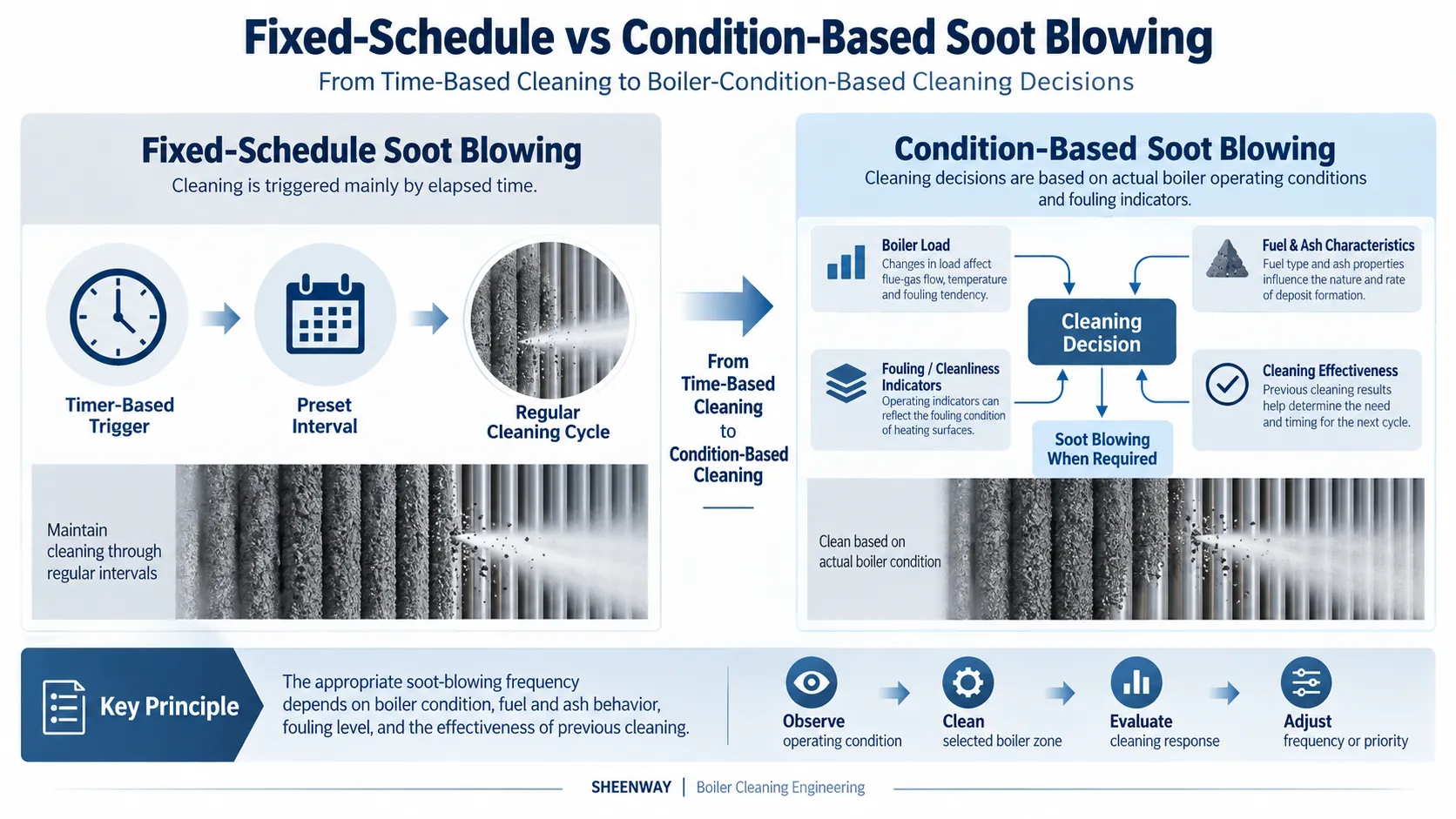
How Often Should a Boiler Be Soot Blown?
One of the most common operating questions about boiler cleaning sounds simple:
How often should the soot blowers run?
In practice, there is no single interval that is technically appropriate for every boiler—or even for every heating surface within the same boiler.
The furnace, superheater, reheater, economizer, SCR system and air preheater operate under different thermal and deposit conditions. Fuel composition changes. Boiler load changes. Ash behavior changes. Even two nominally similar boilers may develop very different fouling patterns.
For this reason, soot blowing is better treated as an operating optimization problem than as a simple timer setting.
The objective is not to operate soot blowers as frequently as possible.
It is to keep boiler surfaces sufficiently clean while avoiding unnecessary cleaning cycles, steam consumption and excessive cleaning exposure.
SHEENWAY's boiler-cleaning guidance follows the same principle: soot-blower frequency, sequence and operating method should be determined according to boiler load, fuel characteristics and the actual fouling condition of the equipment.
Why a Fixed Soot-Blowing Schedule Can Be Inadequate
Traditional soot-blowing systems are often operated according to predetermined schedules.
This approach is straightforward and easy to automate.
However, ash deposition does not necessarily follow a fixed clock.
Peer-reviewed studies of economizers, reheaters and air preheaters have repeatedly found that soot-blowing optimization requires some assessment of actual heating-surface condition rather than relying exclusively on fixed intervals.
The reason is a basic trade-off.
If soot blowing is delayed for too long, deposits can accumulate and reduce heat transfer.
If soot blowing is performed more often than necessary, additional steam is consumed without necessarily producing a proportional improvement in cleanliness.
Frequent direct-jet cleaning can also increase exposure of boiler surfaces to high-velocity cleaning jets and entrained particles. Studies of sootblower-related erosion show that jet conditions and particle impact can contribute to tube material loss.
The technically relevant question is therefore not:
“What is the shortest possible soot-blowing interval?”
It is:
“When does the benefit of cleaning justify another soot-blowing cycle?”
What Determines the Required Soot-Blowing Frequency?
Several variables should be considered together.
1. Boiler Load
Boiler load affects combustion conditions, flue-gas flow, temperatures and heat-transfer behavior throughout the boiler.
A schedule developed under one operating condition may therefore become less representative when the unit operates at a substantially different load.
Recent research on intelligent soot-blowing systems has addressed this directly by establishing different reference conditions for different stable boiler loads rather than treating the boiler as if it had one constant operating state.
This does not mean that every load change should immediately trigger a different soot-blowing cycle.
It means that load is one of the variables that should be considered when interpreting fouling and heat-transfer indicators.
2. Fuel and Ash Characteristics
The amount and behavior of ash entering the boiler depends strongly on the fuel.
Fuel changes can alter:
- ash loading,
- slagging tendency,
- fouling rate,
- deposit strength,
- and the location where deposits become most problematic.
This is why soot-blower sequencing and operating strategy may need to be revised when fuel characteristics change.
Babcock & Wilcox's boiler guidance, for example, states that sootblower sequencing requirements should be established through operating experience and updated when necessary, particularly when fuel characteristics change.
SHEENWAY's SW-SLRG Series documentation follows the same engineering logic: travel speed, rotational speed, nozzle configuration, blowing-medium pressure and flow are determined with reference to flue-gas temperature, fuel, ash content and medium conditions.
3. Actual Fouling Condition
Elapsed time alone cannot tell operators how dirty a heat-transfer surface is.
Ideally, cleaning decisions should incorporate some indication of surface condition.
The difficulty is that ash deposition inside a boiler is often not directly visible during operation.
For this reason, researchers and intelligent soot-blowing systems use indirect performance indicators to estimate surface cleanliness.
Depending on the boiler section and available instrumentation, these can include combinations of:
- calculated heat-transfer performance,
- cleanliness or fouling factors,
- temperature trends,
- draft or gas-side resistance,
- steam-temperature behavior,
- spray-water demand,
- and other plant measurements.
B&W notes that boiler surface fouling often appears indirectly through changes in parameters such as steam temperatures, spray flows and draft losses.
Research on economizers, reheaters and air preheaters has likewise demonstrated methods that derive a fouling or cleanliness indicator from existing plant data and use it to support soot-blowing decisions.
No single indicator, however, should automatically be treated as universally valid for every boiler.
4. The Boiler Zone Being Cleaned
Different boiler sections should not necessarily have the same cleaning frequency.
This is because they do not accumulate the same deposits at the same rate, and they do not have identical cleaning objectives.
Furnace Water Walls
Furnace soot blowers primarily address ash and slag deposits on water-wall surfaces.
SHEENWAY's furnace soot blower documentation allows cleaning parameters such as blowing arc, number of rotations and pressure to be adjusted according to the nature of the deposits and the requirements of the boiler location.
The operating frequency should therefore correspond to the actual slagging and deposition behavior of the furnace rather than simply matching the schedule of downstream equipment.
Superheaters and Reheaters
Convective tube banks can develop fouling that interferes with heat transfer.
Long retractable soot blowers are commonly applied in these regions because the lance can reach deep between heating surfaces.
SHEENWAY's SW-SLRG Series is specifically intended for applications including superheaters, reheaters and economizers.
Research focused specifically on reheater fouling has also shown that different boiler heating elements may accumulate ash at different rates and therefore require different levels and timing of cleaning.
Economizers
Economizer fouling can also be evaluated through heat-transfer performance.
One published optimization study developed a fouling-rate model from DCS and thermodynamic data and demonstrated that an optimum soot-blowing period could be determined by balancing heat-transfer improvement against soot-blowing steam consumption.
The numerical optimum obtained in that particular plant should not be transferred directly to another boiler.
The useful conclusion is the methodology:
the optimum interval depends on the actual fouling behavior and operating economics of the specific unit.
Air Preheaters
Air-preheater fouling affects both heat transfer and gas-side flow resistance.
Research on a 300 MW coal-fired unit demonstrated that air-preheater cleaning frequency and duration could be optimized using a calculated cleanliness factor derived from existing plant operating data.
For SHEENWAY's SW-SAHS Air Preheater Soot Blower, stroke, travel speed and nozzle configuration are also project-dependent rather than fixed universally.
Again, this supports a zone-specific approach to cleaning.
Why More Soot Blowing Is Not Automatically Better
Cleaning a fouled surface provides a benefit.
But each cleaning cycle also has a cost.
For a steam soot blower, one obvious cost is the steam used during operation.
Another consideration is mechanical exposure of the heating surface to the cleaning jet.
Published research on soot-blowing optimization therefore often describes the problem in terms of balancing:
cleaning benefit
against
cleaning cost or loss.
For example, economizer and air-preheater studies have optimized soot-blowing intervals by considering both improvement in heat transfer and the steam consumed during cleaning.
This does not mean that every plant must implement the same mathematical optimization model.
But it establishes an important operating principle:
An additional soot-blowing cycle should produce a useful cleaning benefit.
If repeated operation produces little additional improvement, simply increasing the frequency may not be the most effective response.
The underlying issue may instead be nozzle condition, cleaning coverage, deposit strength, steam conditions or the suitability of the cleaning technology.
How Should the Soot-Blowing Sequence Be Set?
Frequency determines when a region needs cleaning.
Sequence determines which soot blowers operate, and in what order or grouping.
There is no single sequence that should be copied into every boiler.
The sequence must account for:
- boiler geometry,
- soot-blower locations,
- fuel and deposit behavior,
- cleaning priorities,
- available steam or compressed air,
- control-system logic,
- and operating experience.
Industry guidance from B&W specifically states that sequencing requirements should be established from operating experience and modified when necessary.
Modern intelligent soot-blowing systems go further.
Rather than permanently running the same group of soot blowers in the same order, some systems evaluate the cleaning effectiveness of individual blowers and dynamically prioritize those that can provide the greatest benefit when a particular boiler section requires cleaning.
This is an important distinction.
A soot-blowing sequence does not have to be only a fixed list.
It can also become a priority system based on boiler condition and previous cleaning effectiveness.
From Time-Based to Condition-Based Soot Blowing
A useful way to understand soot-blowing control is as a progression.
Level 1 — Fixed Schedule
The simplest system operates selected soot blowers after a fixed period.
Example concept:
Time elapsed → Start cleaning
This is simple and predictable, but it assumes deposition develops at a sufficiently predictable rate.
Level 2 — Operator-Adjusted Schedule
A predefined sequence is retained, but operating staff adjust the frequency based on plant experience, fuel condition and observed performance.
This is already more adaptive than a completely fixed program.
Level 3 — Condition-Based Cleaning
Cleaning decisions are triggered or prioritized based on indicators of actual boiler condition.
Conceptually:
Boiler operating data → Fouling assessment → Cleaning decision
This is the principle behind much of the published research on soot-blowing optimization.
Level 4 — Intelligent Soot Blowing
More advanced systems can combine boiler models, measured operating parameters and the historical effectiveness of individual soot blowers.
A recent peer-reviewed study on a 660 MWe boiler, for example, combined real-time fouling assessment, prediction of cleaning effectiveness and multi-objective optimization to balance cleaning improvement against steam consumption.
These advanced systems are not necessary for every industrial boiler.
But they demonstrate the direction of modern soot-blowing control:
from “blow because the timer expired” toward “blow because the boiler condition indicates that cleaning is worthwhile.”
A Practical Engineering Framework
For plants without a full intelligent soot-blowing system, the same logic can still be applied at a simpler level.
Step 1: Divide the Boiler into Cleaning Zones
Identify the relevant regions:
- furnace,
- superheater,
- reheater,
- economizer,
- SCR,
- air preheater,
- and any other deposit-sensitive equipment.
Step 2: Define the Main Fouling Problem in Each Zone
Determine whether the problem is primarily:
- slagging,
- loose fly ash,
- bonded fouling,
- catalyst plugging,
- air-preheater blockage,
- or another deposit mechanism.
Step 3: Establish a Baseline Program
Use the boiler manufacturer's/OEM's operating requirements, commissioning experience and plant history to establish the initial frequency and sequence.
The baseline is a starting condition—not evidence that the schedule should never change.
Step 4: Monitor Relevant Operating Trends
Evaluate the indicators that are actually meaningful for the relevant heating surface.
These may include heat-transfer calculations, temperature behavior, draft loss, spray flow or other plant-specific parameters.
The correct indicators should be selected for the particular boiler and verified against operating experience.
Step 5: Evaluate Each Cleaning Cycle
After soot blowing, ask:
Did the relevant performance indicator improve?
If cleaning repeatedly produces little measurable benefit, the problem may not be insufficient frequency.
The cleaning mechanism itself may need investigation.
Step 6: Adjust Frequency and Priority
Regions that foul faster or respond strongly to cleaning may justify different treatment from areas that remain relatively clean.
This is essentially the logic used by more sophisticated intelligent soot-blowing systems, which can dynamically prioritize blowers based on cleaning effectiveness.
When Should the Existing Schedule Be Re-Evaluated?
A soot-blowing program should be reviewed when the conditions on which it was based have changed.
Examples include:
A change in fuel or fuel blend
Different ash properties can alter where and how quickly deposits develop.
Persistent deterioration in heat-transfer performance
If a heating surface loses performance faster than before, its fouling behavior may have changed.
Increasing draft loss or gas-side resistance
This may indicate increasing restriction in appropriate boiler sections, though the cause should be diagnosed rather than assumed.
A change in the effectiveness of a soot blower
If operating the same blower produces less improvement than previously, inspection of cleaning coverage, lance condition, nozzle condition, blowing medium and deposit characteristics may be required.
Evidence of excessive erosion or component wear
Increasing frequency is not an appropriate response when the cleaning process itself may be contributing to damage.
The schedule and the equipment condition should be evaluated together.
Soot Blowing Is a System, Not a Timer
The most important operating principle is therefore relatively simple:
A soot blower should not operate simply because a predetermined number of hours has passed.
Nor should a plant wait until fouling has already caused serious operational deterioration.
The objective is to establish a cleaning strategy in which each boiler zone is cleaned often enough to maintain acceptable performance—but not more often than the operating benefit justifies.
That requires the combination of:
equipment design + fuel behavior + boiler operating data + deposit condition + cleaning effectiveness.
As monitoring and control systems become more advanced, the same principle can be implemented with increasingly sophisticated models.
But the underlying engineering logic remains unchanged.
Conclusion
There is no universal answer to the question:
“How often should a boiler be soot blown?”
The appropriate frequency depends on the boiler section, operating load, fuel and ash characteristics, actual fouling condition and the effectiveness of the cleaning action.
Likewise, soot-blowing sequence should not be treated as a fixed universal order. It should be established according to boiler design and operating experience and revised when actual conditions justify a change.
SHEENWAY's own product and boiler-cleaning documentation follows this application-specific principle. Operating frequency and sequence are selected according to actual boiler conditions, while important equipment parameters are determined from variables including flue-gas temperature, fuel, ash and blowing-medium conditions.
The objective of an effective soot-blowing strategy is therefore not maximum cleaning activity.
It is:
the right cleaning action, in the right boiler zone, at the right time.
More from Sheenway
Continue Reading
Retractable Boiler Temperature Probe: Why It Matters During Boiler Startup
During boiler startup, furnace exit gas temperatures can rise before sufficient steam cooling is established in certain heating surfaces. A retractable boiler temperature probe positions a thermocouple in the gas path to provide temperature information for operating decisions. This guide explains the working principle, startup applications, measurement limitations and selection requirements of the SHEENWAY SW-MTPS.
Read articleRake-Type Soot Blower Design for SCR: Nozzle Layout, Travel and Support
Rake-type soot blowers use non-rotating, axially moving cleaning assemblies to direct steam or compressed air toward SCR catalysts and other structured surfaces. This guide explains nozzle layout, travel, support and guide arrangements, cleaning-medium conditions and the engineering checks required before selecting or replacing a rake-type soot blower.
Read articleMulti-Medium Retractable Soot Blowers: When Steam Alone Is Not Enough
Steam soot blowing is effective for many boiler cleaning applications, but certain gypsum, salt and strongly bonded deposits may require additional cleaning methods. This guide explains how multi-medium retractable soot blowers combine different cleaning options, when water washing may be considered, and how engineers select an appropriate solution for gas-gas heaters and air preheaters.
Read article